Showing posts with label cost. Show all posts

Tuesday, May 28, 2019

The Cost of Freedom


This is the text of the reflections I offered on Sunday, May 26, 2019 to the congregation I serve in Charlottesville, Virginia.


Every year until his death in 2012, Senator Daniel Inouye introduced legislation to change the date of Memorial Day from what it is now, the last Monday in May, back to what it had been before, May 30th (regardless of what day that fell on in any given year).  That change occurred back in 1968.  If Inouye, who entered the Senate in 1963, took up this cause immediately, he would have introduced this bill over 40 times.

Marking Memorial Day on May 30th goes back to the mid-1800s.  The precursor of Memorial Day was Decoration Day.  The “official” history, the one we most likely learned in school (if we learned about any of this at all), is that in 1868, three years after the Civil War ended, the head of an organization of Union veterans, Maj. Gen. John A. Logan, declared that May 30th should be a day for decorating the graves of the more than 620,000 soldiers who died during the war, “whose bodies,” he wrote, “now lie in almost every village and hamlet churchyard in the land.”   It didn’t matter on which side of the war you’d fought – Logan believed that the ultimate sacrifice paid by both Union and Confederate soldiers alike deserved to be remembered.  It is said that he thought the day should be celebrated in the spring, and that May 30th was chosen because it was a date on which no battle had been fought, making it a day to honor all the soldiers who died in all the battles of the war.

The story we most likely weren’t taught in school is that in 1865, at the very tail end of the war, as the white residents of Charleston, South Carolina fled the city in advance of the arrival of Union troops, the Black citizens remained, welcoming the troops back to the city where the war had begun four years earlier. 

A makeshift prison for Union soldiers had been erected in the middle of what had been a race track.  The men who died there buried hastily in a mass grave.  After the Union soldiers arrived, Black workmen from Charleston dug up the remains of those soldiers and re-buried them with proper respect, creating a proper cemetery.  Above the entrance they placed a sign that read, “Martyrs of the Race Track.”  This new cemetery was dedicated on May 1st, with a parade that included 10,000 people and which the New York Tribune described as “a procession of friends and mourners as South Carolina and the United States never saw before.”  It seems to me that this, truly, was the 1st Decoration Day, and is the real root of our modern Memorial Day.

But why did Senator Inouye, and a large number of veteran’s groups, care about the date on which Memorial Day fell?  Why would he try year after year for more than forty years to get it changed?  The last Monday in May is easy to remember and plan for; May 30th would be a Saturday one year and then a few years later it’d be a Wednesday; it’d keep moving throughout the week.  Inouye fought for the change in part because the last Monday in May made it so easy to plan for.  He, and as I said, a great many others, feared that what was going to be planned for each year was not how to honor the people who had died while serving in our nation’s military.  Instead, people would be figuring out what to do with a three-day weekend and the official beginning of summer.  In 2015, Marine Corps veteran Jennie Haskamp wrote a piece for The Washington Post in which she shared her frustration that meaning of Memorial Day had become “grilled meat, super-duper discounts, a day (or two) off work, beer, potato salad and porches draped in bunting.”  She argued that it should be a day to remember and reflect on the truth that freedom comes at a cost.

Stephen Stills – of Crosby, Stills, Nash, and Young – wrote a haunting song called, “Find the Cost of Freedom” which came out as the B side to their song, “Ohio,” written about the Kent State massacre.  The song is deceptively simple – it’s just two lines long:

“Find the cost of freedom buried in the ground. 
Mother Earth will swallow you, lay your body down.” 

Simple, right?  The complexity, the ambiguity of the song comes when you ask yourself who it’s talking to and what it’s talking about.  Soldiers are told that they are fighting for freedom, fighting to defend democracy, fighting to make the world more safe.  And I don’t know anyone who has ever served in the military, especially during times of war, who doesn’t know all too well that those things come at a cost.  Rows, and rows, and rows of headstones in Arlington National Cemetery; column after column, line after line of names on those polished black granite walls of the Vietnam War Memorial.  More importantly, and more impactfully, the cost of this particular father/mother/brother/sister/friend who will never attend another Memorial Day picnic.  This may not have been the band’s intention, but this song is talking to and about them.

At the same time, though, those who were protesting the military industrial machine also saw themselves as fighting for freedom; it was clear that they, too, needed to be willing to “lay their body down.”  And nearly every mass protest since, nearly every concerted effort for change, has seen at least some, “buried in the ground.” The song talks to, and about, them as well.

There are a number of different kinds of freedom, all of which come at a cost.

A woman who speaks up about sexual harassment in the workplace, seeking freedom from the prison of misogyny, has often paid for that freedom with the loss of her position and having her reputation dragged through the mud.  A trans teen who comes out, seeking freedom from the false identity society demands of them, may pay the cost of that freedom in rejection by family and friends, and all too often with emotional, psychic, and bodily harm.  A woman of color who dares to speak her truth in her own voice, seeking freedom from the oppression of a society that demands she speak and act in ways acceptable to white folk, can pay for that freedom by having to endure an angry backlash and attacks on her character.

There is a cost to freedom.

When someone comes to realize that divorce is the right thing for them, seeking freedom from a painful and maybe even dangerous marriage, they pay for that freedom in friends who take sides, loss of income, or status, or the dream of what they’d thought life would be like.  Choosing to leave the safety of a career, seeking freedom from something soul-sucking to pursue a passion, has the cost of the incredulity of those around them and the loss of what our society deems “security.”

The Catholic priest and Trappist monk Fr. Thomas Merton said that the purpose of our lives is to free ourselves from the “false self” in which we are trapped, so that we can live deeply, fully, richly the life of our “true self.”  This is something every religious tradition teaches – that we live imprisoned in suffering, delusion, sleep, sin, not-life, and that we should wake up and strive for freedom.

In the Hebrew scriptures it is said that it took Moses and the Israelites 40 years of wandering in the desert after leaving their captivity in Egypt before they entered the Promised Land of Canaan.  The distance between the two could actually have been traversed in less than two weeks.  One rabbinic interpretation is that God led them on that long, wandering way because all of those who had grown up with a captive’s experience and a captive’s mentality had to die before the people could enter the freedom of the Promised Land. 

Is there something in your life that you feel traps you, preventing you from living full and free?  Is there something that you do, or don’t do, because you feel that you “should,” or that it’s “expected” of you?  Is there some part of you that is stunted, held back, imprisoned?  Our faith challenges us to risk the discomfort, the pain, even, of striving for freedom – ours and that of “all of us imprisoned,” as our Opening Hymn put it. 

It tells us too, though, that there will always be a cost.  The journey from what was to what can be always requires us to leave things behind, even things that have been precious to us; it always calls for a “death” of some kind.  That is why so many of us so rarely attempt it.  We fear the cost will be too high.  Yet the experience of those who have come before us, and even our own lived experience, tells us that the cost of not making this journey, of remaining in our prisons, is even higher still.

This is one of the reasons that we so highly value community, because change is frightening and potentially dangerous … nearly impossible if we try it alone.  Together, though, we can encourage one another, inspire one another, carry one another when the going gets really tough.  And when we make it to the other side, enter the freedom of our own “promised land,” we may one day be able to look back at that which we left behind, that which had had to die, and then clean and decorate their graves knowing that the cost we paid was worth it.

May it be so.


Monday, August 06, 2018

8-15-8-6-45


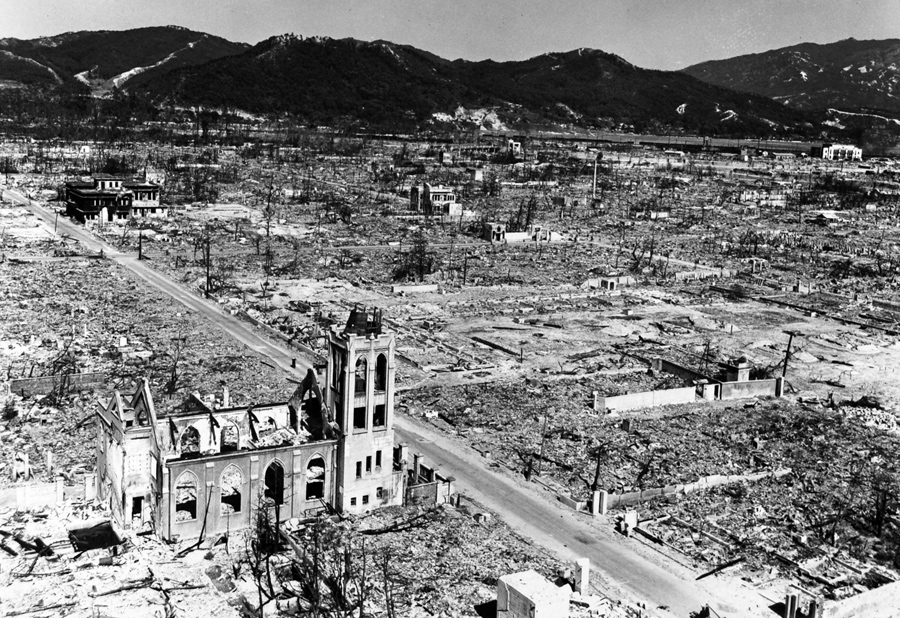
Today is the anniversary of the bombing of Hiroshima, Japan 73 years ago.  At the time of the bombing the city's population was approximately 340,00 - 350,000 people.  It is estimated that the bomb directly killed 70,000 people, including 20,000 Japanese combatants and 2,000 Korean slave laborers. By the end of the year, injury and radiation brought the total number of deaths to 90,000–166,000.  About 70% of the city's buildings were destroyed, and another 7% severely damaged.  This was the first time an atomic bomb was dropped on a city.  

Two days later another bomb was, this time on the city of Nagasaki.  At the time, the population of Nagasaki was estimated to be about 263,000 people -- 240,000 Japanese residents, 10,000 Korean residents, 2,500 conscripted Korean workers, 9,000 Japanese soldiers, 600 conscripted Chinese workers, and 400 Allied POWs  Less than a second after the detonation, the north of the city was destroyed and 35,000 people were killed.

On August 12, 2007 I preached this sermon at the congregation I was serving in Brewster, Massachusetts.  While many of the specifics are clearly of the time, I think the message still has relevance.


Opening Words:  The End and the Beginning


After every war
someone has to clean up.
Things won't
straighten themselves up, after all.

Someone has to push the rubble
to the sides of the road,
so the corpse-laden wagons
can pass.

Someone has to get mired
in scum and ashes,
sofa springs,
splintered glass,
and bloody rags.

Someone must drag in a girder
to prop up a wall.
Someone must glaze a window,
rehang a door.

Photogenic it's not,
and takes years.
All the cameras have left
for another war.

Again we'll need bridges
and new railway stations.
Sleeves will go ragged
from rolling them up.

Someone, broom in hand,
still recalls how it was.
Someone listens
and nods with unsevered head.
Yet others milling about
already find it dull.

From behind the bush
sometimes someone still unearths
rust-eaten arguments
and carries them to the garbage pile.

Those who knew
what was going on here
must give way to
those who know little.
And less than little.
And finally as little as nothing.

In the grass which has overgrown
causes and effects,
someone must be stretched out,
blade of grass in his mouth,
gazing at the clouds.


by Wislawa Szymborska 

(translated by Joanna Trzeciak)

Szymborska is a Polish poet and essayist.
She won the Nobel Prize for Literature in 1996. 


Reading:  “Ten-fifteen. The garden sprinklers whirled up in golden founts, filling the soft morning air with scatterings of brightness. The water pelted windowpanes, running down the charred west side where the house had been burned evenly free of its white paint. The entire west face of the house was black, save for five places. Here the silhouette in paint of a man mowing a lawn. Here, as in a photograph, a woman bent to pick flowers. Still farther over, their images burned on wood in one titantic instant, a small boy, hands flung into the air; higher up, the image of thrown ball, and opposite him a girl, hand raised to catch a ball which never came down. The five spots of paint- the man, the woman, the children, the ball- remained. The rest was a thin charcoaled layer.”

From “There Will Come Soft Rains” by Ray Bradbury.

* * *


At 8:14 there was a clear blue sky.  Birds flew in the morning sunshine.  Children laughed as they made their way to school.  People were doing tai chi and calisthenics in a city park.  There’d been a scare earlier in the morning but it seemed now that everything was okay.  Even when the world around you seems to be going crazy, days like this can make you feel alive and grateful.  The air is clean; the sun, warm.  You can forget the insanity.  On a day like this.  For a moment everything makes sense.
And in that moment—31,000 feet above the birds, and the children, and the men doing tai chi—the bomb doors on the Enola Gay opened and let loose a metal cylinder.  Ten feet long and two-and-a-half feet in diameter, it would change the world.  Not just for the people below or the people in the plane, but for every man, every woman, and every child who lived or ever would.
Forty-three seconds after it was flung loose that metal cylinder was 1,900 feet above the ground and it exploded with the force of 15,000 tons of TNT.  The birds burst into flame in mid-air.  So did combustible things like paper—even as far as a mile away.  Instantly.
The people in the park right below turned to ash.  Instantly.  A woman sitting on the steps of her bank, waiting for it to open, was reduced to a shadow.  You can see it today in the Hiroshima Peace Museum where they moved the steps so that she might not be forgotten.
Next came the blast wave.  Moving at a rate of two miles a second, people were blown from their feet, buildings were blown to the ground, trolleys and cars were blown from the roads.  Glass shattered twelve miles away.  A boy was blown through the windows of his house and across the street; his house collapsing behind him.  Within minutes, nine out of ten people half a mile or less from ground zero were dead.
And the numerous fires that erupted around Hiroshima soon joined together creating a monstrous firestorm that engulfed nearly four and half square miles of the city.  In its heart it is estimated that this beast reached temperatures of over seven thousand degrees.  (For comparison, the surface of the sun is just under ten thousand degrees.)  An interesting fact:  a postwar study showed that less than 4.5 percent of survivors of the bombing of Hiroshima suffered leg fractures.  That’s not, of course, because those injuries didn’t occur but because those who couldn’t walk died.
It’s estimated that somewhere around 100,000 people died as a direct result of the blast and the fires.  100,000 people. 
Yet these are just numbers:  15,000 tons of TNT.  Seven thousand degrees.  100,000 people dead.  60 million dead if you add in all those—military and civilians—who died during World War II. 
And wasn’t it World War I that was called “the war to end all wars”?
But it didn’t, did it?  And neither did World War II.  Or the Korean War.  Or Vietnam.
And now we’re embroiled in a war which we started without provocation, a “pre-emptive war” which it is clear that our leaders lied us into launching.  Over 135,000 people have died, and our country alone has spent roughly $451,345,000,000 on the war—that’s as of 9:00 this morning when I checked a running total on the web.  The money we’ve spent on the war in Iraq could have paid for 59,780,739 kids to attend Head Start, nationwide, for a year.  Or it could have built 114,832 additional units of affordable housing in Massachusetts.  Or it could have hired 7,170 new public school teachers in Barnstable County alone.  So, what is the cost of this war?
Yet even more important than that is the question, “what is the cost of war?”  Any war?  What do we loose—not just how many lives are lost but how much Life is lost—when nations take up arms against each other? 
How is it possible that we haven’t stopped fighting yet?  After Hiroshima, Nagasaki, Dresden, Pearl Harbor, the Congo, Korea, Rwanda, Cambodia, Afghanistan, Sarajevo, Somalia, Northern Ireland, New York City, Bagdad—how can we still be slaughtering one another?  It’s been over thirty years since Edwin Starr shouted out, “War.  What is it good for?”  and answered himself, “Absolutely nothin’.”  How is it that we haven’t learned?
Maybe it’s because we keep talking about numbers.  Joseph Stalin said that the death of one person is a tragedy, while the death of millions is a statistic. But there are no statistics.  There is no such thing as “collateral damage.”  There are only people—mothers, fathers, sons, daughters, grandparents, grandchildren, neighbors, friends.  Strangers, even.  Enemies, even.  But no numbers.  Numbers don’t exist; only people do.  Until they don’t anymore.  Until they become shadows in a museum.
Or maybe it’s because we keep thinking that we can fight our way to peace, that the problem is some bad people over there and if we can just beat them into submission peace will prevail.  We believe that it’s in talking tough, acting tough, that we protect the peace.  We’re told—and many believe—that the best defense is a good offense and that while might might not make right, might in the hands of the good guys is there to be used.
Or maybe we’re still warring even with the mushroom cloud in our memories because we haven’t really explored an alternative.  One thing that gives me hope is the legislation currently before the U.S. House of Representatives to create a United States Department of Peace.  This legislation would:
l     Create a cabinet level position—the Secretary of Peace—who would be equal to the Secretary of Defense and the Secretary of State and would advise the president on peacebuilding needs, strategies, and tactics for use both domestically and internationally.
l     It would create a Peace Academy, on a par with our military service academies, which will build a world-class faculty of peacebuilding experts who would be able to analyze peacebuilding strategies at the highest level, advise other branches of government, and facilitate the training of peacebuilders for domestic and international service. 
l     This legislation calls for funds to create and expand proven domestic peace building programs in our communities.

In short, the Department of Peace would be dedicated to discovering, developing, and deploying methods to meaningfully prevent conditions of conflict before violence erupts—both abroad and at home.

Now, of course, lots of individuals and groups think that that’s just a nutty idea.  But peace will never be found at the end of the barrel of a gun.  Remember the quotations from the first of our peace services last year:
l     If we have no peace, it is because we have forgotten that we belong to each other.
~ Mother Teresa
l     There is no way to peace. Peace is the way.  ~ A.J. Muste
l     Peace is not merely the absence of war. It is also a state of mind. Lasting peace can come only to peaceful people.  ~ Jawaharlal Nehru
l     Peace is more important than all justice; and peace was not made for the sake of justice, but justice for the sake of peace.  ~ Martin Luther
I think that it was Einstein who, after seeing the devastation of the atomic bomb, said that humankind had progressed so far technologically that we now needed an evolution of consciousness if we hoped to survive.  And Al Gore, in his film An Inconvenient Truth, made the point that when old habits—and he used the example of humanity’s penchant for warfare—are joined to new technology—and here he showed a picture of an atomic mushroom cloud—the results can be devastating and so we have to somehow learn to break our old habits.
This week saw the sixty-second anniversary of the bombings of Hiroshima and Nagasaki.  During the service I’ve had this metronome beating out as fast as it can, and if each beat represents one person—one mother, father, husband, wife, sister, brother, daughter, son who died from the immediate effects of the bombing on August 6th—then when our hour is up . . . at this rate . . .  we will be halfway through remembering them all.
But it’s not about numbers, and it’s not even about what has been done.  It’s about people, and about what we can do.  I’d like to see First Parish take its place as a leader in this work for peace.  We have strongly staked our place as an open, anti-oppression congregation.  I would like to see us take and equally solid stand as a place of peace. 
We are known for stands against the demonization of people because of their race, or their gender expression, or their sexual orientation; I would like us to become known for standing against the demonization of people because of their nationality or their ideology.  We are engaged with the work of ending violence in the home, let’s expand that to our world home.  Let’s build on the work we’re already doing—which so many of us as individuals are already involved in—and make peace one of our priorities.
Protests, vigils, letter writing, hosting community forums, working on legislation, running for office . . . we can do so many things.
I’ll end with one of my favorite quotes.  Edward Everett Hale.  “I am only one, but still I am one.  I cannot do everything, but still I can do something.  And because I cannot do everything, I must not fail to do the something that I can.”


Closing Words:  Every Day


War is no longer declared,
only continued. The monstrous
has become everyday. The hero
stays away from battle. The weak
have gone to the front.
The uniform of the day is patience,
its medal the pitiful star of hope above the heart.
The medal is awarded
when nothing more happens,
when the artillery falls silent,
when the enemy has grown invisible
and the shadow of eternal armament
covers the sky.
It is awarded
for desertion of the flag,
for bravery in the face of friends,
for the betrayal of unworthy secrets
and the disregard
of every command.

by Ingeborg Bachmann, Austiran poet