Preparation for the Sermon: Can you feel it in the air? The Holiday season is just around the
corner. For some this is a time filled
with stress, maybe with loneliness or with sorrow. Or maybe even with anger at the commercialism
which invades what used to be sacred space and time. But for me…..
Wow! Thanksgiving season is the
beginning of a magical time. A time of childish
wonder and of rich traditions and memories!
Actually, you have most likely seen the picture of my childhood
Thanksgivings. Norma Rockwell painted
it. The grandparents, the table crowded
both with people and with all the traditional dishes—mashed potatoes and gravy,
candied sweet potatoes, cranberry salad, green beans, pecan pie and, of course,
that beautiful golden brown turkey being carried in triumph to the table.
That was my childhood Thanksgiving. A small Midwestern town. The big white house
with the turreted front parlor, the wrap around front porch. The coats piled in the entrance room on the
bench, hats perched on the antlers of the Stag hanging on the wall. And people….me and my brothers and sisters,
mom and dad and my Grandparents, Aunts, uncles, cousins…and cousins….and
cousins. We could be a mass of humanity
numbering 30 to 40 filling that big white house with the roars of greeting and
the squeal of children wallowing in hugs and kisses from doting aunts and
uncles and grandparents.
There was the baby grand piano around which we gathered to
sing (Often in 4 part harmony), the living room where we crowded onto sofas and
laps and spilled over to fill the oriental carpet on the floor for the stories
and the now lost art of the parlor games.
There was the traditional touch football game in the sprawling side
yard, and the climbing race to the top of the three story blue spruce in the
back yard. And the aromas which filled every room with the hints of the dinner
feast soon to follow. It was
idyllic. Everything was perfect. Everyone was perfect. Life was perfect. And the world was
perfect.
And it remained that way until one day in college when I
learned that my perfect Midwestern town was a hotbed for the Klu Klux Klan, and
home to three John Birch Society chapters and that during the height of the
civil rights marches, town fathers were on the roofs of the Elks and the Moose
lodges on opposite ends of town with rifles and shotguns waiting for those
people to try to march into our town.
The Norman Rockwell façade began to fade away as the realities of the
underbelly of my perfect town were exposed.
And with the passage of time and of childhood innocence, my
perfect family began to take on more of the tarnish of common humanity. I can now see that the holiday suits,
dresses, perfumes and colognes only disguised the grudges and resentments and
harsh criticism underneath and do not resolve them. That, in addition to the hugs and the
casseroles and the candies and the flowers, other things also come in through
the door on Thanksgiving day. My
father’s and my uncle’s alcoholism. My
aunt’s mental illness. My cousin’s teen-age
pregnancy. My sister’s rape. My cousin’s drug dealing and drug abuse. These were also present within the annual
family gathering. As a wide eyed boy I
was totally oblivious to most of this history.
Even in adulthood it was never discussed –seldom even acknowledged
openly.
Yet this morning, I can still recall those Thanksgivings of
my childhood and how they were filled with love, with music and laughter, the
sense of belonging. I no longer see the
world as perfect or my family as perfect.
And, despite the erosion of some of my childhood naïveté, this remains a
Norman Rockwell, magical time for me. I
celebrate with thanksgiving for the goodness that coexists in the midst of the
imperfection. It is a time to gather
together, to remember, to celebrate and to be grateful. Happy Thanksgiving. (Bob Kiefer)
* * *
The Thanksgiving legend begins in Plymouth,
Massachusetts. The original feast was
probably held in early October 1621 and was celebrated by the 53 Pilgrims who
survived that first year, along with the Wampanoag chief Massasoit and 90 of
his men. Rather than the one day event we’ve become accustomed to – followed by
the obligatory “Watching of the Football Game” – this so-called “first thanksgiving” apparently
lasted for three days and featured a menu including numerous types of
waterfowl, wild turkeys, fish, and lobster, procured by the colonists, and five
deer brought by the Native Americans. (Right
now there’s a debate among some of my friends on FaceBook about whether or not
seal was also on the menu.)
Of course, now that I live here instead of on Cape
Cod I feel compelled to note that many historians point out that the first
thanksgiving celebration in what would become the United States was actually
held here in Virginia, where Thanksgiving services were routine as early as
1607. (Take that, Massachusetts!)
Be that as it may, though, in the popular mind the
“first Thanksgiving” took place in Plymouth, and the Commonwealth of
Massachusetts has staged a reenactment of Thanksgiving each year since 1921 (which
was the 300th anniversary of that 1621 harvest festival). People gather in 17th century costume at a church on the site of the
Pilgrims' original meeting house. After prayers and a sermon, they march to
Plymouth Rock. Not surprisingly, this annual event has become something of a
tourist attraction.
1970 was the 350th anniversary of the Pilgrim's
arrival. Wamsutta, a Wampanoag elder,
had been invited to the festivities to speak on behalf of the Native
peoples. The planning committee saw a copy
of Wamsutta's intended remarks in advance, however, and they expressed concerns
over what they described as the "inflammatory nature" of the
speech. They actually went so far as to
have a PR person rewrite it and they told him that he could either read their
revision or be disinvited.
"It is
with mixed emotion that I stand here to share my thoughts. This is a time of
celebration for you - celebrating an anniversary of a beginning for the white
man in America. A time of looking back, of reflection. It is with a heavy heart
that I look back upon what happened to my People.
Even before
the Pilgrims landed it was common practice for explorers to capture Indians,
take them to Europe and sell them as slaves for 220 shillings apiece. The
Pilgrims had hardly explored the shores of Cape Cod for four days before they
had robbed the graves of my ancestors and stolen their corn and beans. Mourt's
Relation describes a searching party of sixteen men. Mourt goes on to say
that this party took as much of the Indians' winter provisions as they were
able to carry.
Massasoit, the
great Sachem of the Wampanoag, knew these facts, yet he and his People welcomed
and befriended the settlers of the Plymouth Plantation. Perhaps he did this
because his Tribe had been depleted by an epidemic. Or his knowledge of the
harsh oncoming winter was the reason for his peaceful acceptance of these acts.
This action by Massasoit was perhaps our biggest mistake. We, the Wampanoag,
welcomed you, the white man, with open arms, little knowing that it was the
beginning of the end; that before 50 years were to pass, the Wampanoag would no
longer be a free people.
What happened in those short 50 years? What has happened in the last 300
years?"
The Thanksgiving legend and the Thanksgiving reality
do not always line up neatly.
In Steve Amick's book
The Lake, The River, and theOther Lake, there is a scene which reminded me of something the theologian
Fred Buechner said about the Christian Scriptures – it’s "not too good to
be true, it's too good
not to be true." As far as I can tell, nothing like this ever
actually happened, but it should have . . . and it most certainly has in
countless imaginations. The scene involves
Chief Joseph One-Song, an apparently fictional Ojibwe chief who, as one
character put it, "knew how to make a statement." In the
story Chief One-Song is invited to speak before the U.S. Congress in January
1837 at the granting of Michigan's statehood.
Let me read a bit of the book:
"The
chief's speech was actually only two lines – eight words plus a healthy helping
of wheeze and spittle . . . In translation from the Ojibwe, roughly: "You
have all been a great disappointment. When are you leaving?"
I can't find this anywhere in the history books but,
as I said before, it should be. It's
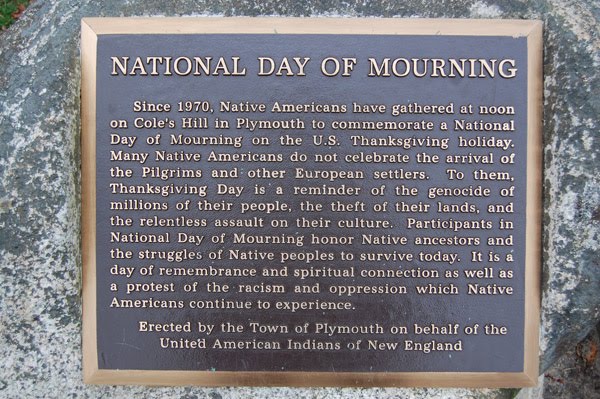
essentially what Wamsutta said at the first National Day of Mourning, that
Massasoit's "peaceful acceptance" of the Pilgrims was "perhaps
[the Wampanoag's] biggest mistake."
Now I feel compelled to point out that the
NationalDay of Mourning, itself, is not without its controversy, even within the Native
American community. Russell Peters, one-time
President of the Mashpee Wampanoag Tribal Council has written:
"While the `Day of Mourning' has served to focus
attention on past injustice to the Native American cause, it has, in
recent years, been orchestrated by a group calling themselves the United
American Indians of New England. This group has tenuous ties to any of the
local tribes, and is composed primarily of non-Indians. To date, they have
refused several invitations to meet with the Wampanoag Indian tribal councils
in Mashpee or in Gay Head. Once again, we, as Wampanoags, find our voices and
concerns cast aside in the activities surrounding the Thanksgiving holiday in
Plymouth, this time, ironically, by a group purporting to represent our
interests."
And so even the protest is protested. Yet that makes the confusion greater not
less, doesn't it? Is the third Thursday
in November a Day of Thanksgiving or a Day of Mourning? Is it a day to celebrate universal
brotherhood and sisterhood, or a day to remember broken promises and a history
of oppression? Should we feel grateful? Or guilty?
These questions bring to mind for me some of my
favorite words from the author E.B. White:
"If the world were merely seductive, that would
be easy. If it were merely challenging, that would be no problem. But I arise
in the morning torn between a desire to save the world and a desire to savor
the world. This makes it hard to plan the day."
Because it's not just Thanksgiving Day that offers us
such a conundrum. It's virtually every
day. If you read the paper before
heading out in the morning do you curse the world or marvel at the blue
sky? Do you despair about the world
we're leaving our children, or wonder at the hope they innocently offer?
It’s often said that most ministers really only have
one sermon that they keep repeating in different forms. I think I have at least a couple. And one of them is that we need to strive to
retrain ourselves away from either/or thinking so that we can embrace the world
as it is, which is both/and. We are
called to save the world and to savor it – both. Life is full of sorrow and of joy – both. The glass is half full and it's half empty – both.
Actually, I saw a great cartoon recently. It shows a glass with water up to the midway
point. A line points at the bottom and
says, “1/2 water.” Another line points
to the top and says, “1/2 air.” The
caption reads, “
Technically, the glass is always full.”
Two weeks ago we talked about the importance of having a
practice of gratitude, the development of an intentional awareness of the
miracles that surround us. And remember
Thich Nhat Hanh’s saying that the miracle is not “walking on water or walking
in the air but simply walking on this earth.”
Even without burning bushes we are surrounded by miracles.
Last week, though, we noted that sometimes life is hard –
sometimes really, really hard – and it might then seem to be impossible to be
grateful. And yet, perhaps, it’s exactly
at such times that it’s most important.
This week I want to make things a little more complicated
because, of course, we live in a really complicated world. Photons act as both waves and particles. 83% of the universe is something called “dark
matter” that we’re not even entirely sure exists. And, of course, the world is both challenging
and seductive, in need of saving and savoring both.
So the question this sermon was advertised to be about –
whether this coming Thursday is a Day of Thanksgiving or a Day of Mourning –
turns out to be just one version of a question we face all the time. It’s the same question as to whether Thomas
Jefferson is a paragon of liberty or a paradigm for oppression? It’s the question Bob brought home even more
personally for us – does the family glitter or is it deeply tarnished? Is this
Norman Rockwell or
Dorothea Lange?
I’m going to let you in on a little secret. There isn’t an easy answer. There isn’t some over simplification that
will work out all of the ambiguities and contradictions.
Life is messy. It
just is. It’s not always fair. Even when it
seems fair in hindsight we discover how unfair it really was; and
sometimes when it seems downright mean-spirited we look back to discover
tremendous gifts. As Ian Anderson said
so long ago, “
Nothing’s easy.”
The world we live in is not “black and white.” It’s not even “shades of grey.” It’s multicolored, a rainbow, with every
color coming in myriad hues and tones and shades. And the religious tradition we share, our
Unitarian Universalist faith, calls on us to recognize this complexity; to
acknowledge it; to embrace it; and to live in it.
There is much suffering, and there is cause for
celebration. There is promise, and there
is pain. Can you hold that? Can you live in that? Can you love that?