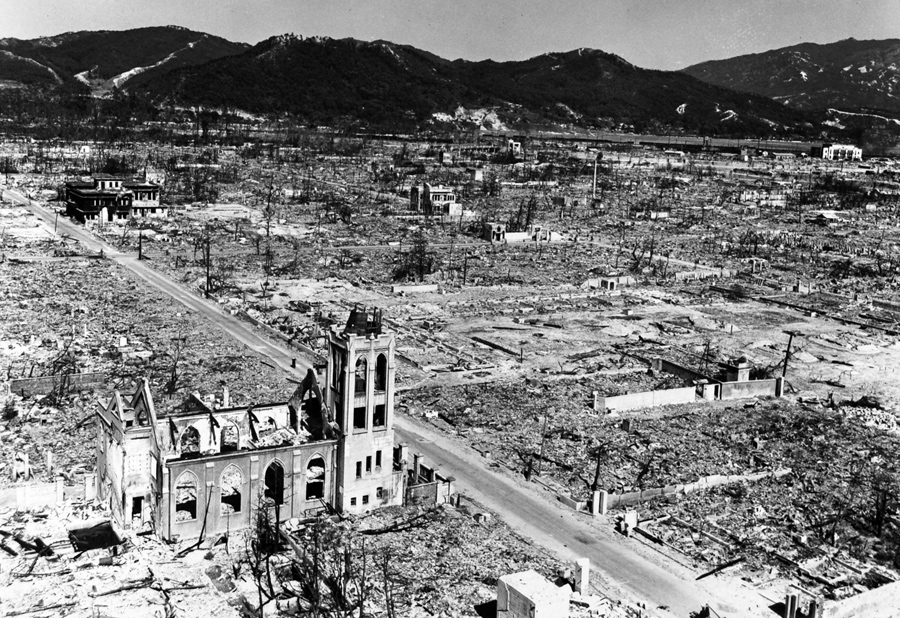
Today is the anniversary of the bombing of Hiroshima, Japan 73 years ago. At the time of the bombing the city's population was approximately 340,00 - 350,000 people. It is
Two days later another bomb was, this time on the city of Nagasaki. At the time, the population of Nagasaki was estimated to be about 263,000 people -- 240,000 Japanese residents, 10,000 Korean residents, 2,500 conscripted Korean workers, 9,000 Japanese soldiers, 600 conscripted Chinese workers, and 400 Allied POWs Less than a second after the detonation, the north of the city was destroyed and 35,000 people were killed.
On August 12, 2007 I preached this sermon at the congregation I was serving in Brewster, Massachusetts. While many of the specifics are clearly of the time, I think the message still has relevance.
Opening Words: The End and the Beginning
After every war
someone has to clean up.
Things won't
straighten themselves up, after all.
Someone has to push the rubble
to the sides of the road,
so the corpse-laden wagons
can pass.
Someone has to get mired
in scum and ashes,
sofa springs,
splintered glass,
and bloody rags.
Someone must drag in a girder
to prop up a wall.
Someone must glaze a window,
rehang a door.
Photogenic it's not,
and takes years.
All the cameras have left
for another war.
Again we'll need bridges
and new railway stations.
Sleeves will go ragged
from rolling them up.
Someone, broom in hand,
still recalls how it was.
Someone listens
and nods with unsevered head.
Yet others milling about
already find it dull.
From behind the bush
sometimes someone still unearths
rust-eaten arguments
and carries them to the garbage pile.
Those who knew
what was going on here
must give way to
those who know little.
And less than little.
And finally as little as nothing.
In the grass which has overgrown
causes and effects,
someone must be stretched out,
blade of grass in his mouth,
gazing at the clouds.
someone has to clean up.
Things won't
straighten themselves up, after all.
Someone has to push the rubble
to the sides of the road,
so the corpse-laden wagons
can pass.
Someone has to get mired
in scum and ashes,
sofa springs,
splintered glass,
and bloody rags.
Someone must drag in a girder
to prop up a wall.
Someone must glaze a window,
rehang a door.
Photogenic it's not,
and takes years.
All the cameras have left
for another war.
Again we'll need bridges
and new railway stations.
Sleeves will go ragged
from rolling them up.
Someone, broom in hand,
still recalls how it was.
Someone listens
and nods with unsevered head.
Yet others milling about
already find it dull.
From behind the bush
sometimes someone still unearths
rust-eaten arguments
and carries them to the garbage pile.
Those who knew
what was going on here
must give way to
those who know little.
And less than little.
And finally as little as nothing.
In the grass which has overgrown
causes and effects,
someone must be stretched out,
blade of grass in his mouth,
gazing at the clouds.
by Wislawa Szymborska
(translated by Joanna Trzeciak)
Szymborska is a Polish poet and essayist.
She won the Nobel Prize for Literature in 1996.
From “There Will Come Soft Rains” by Ray Bradbury.
* * *
At 8:14 there was a clear blue sky. Birds flew in the morning sunshine. Children laughed as they made their way to school. People were doing tai chi and calisthenics in a city park. There’d been a scare earlier in the morning but it seemed now that everything was okay. Even when the world around you seems to be going crazy, days like this can make you feel alive and grateful. The air is clean; the sun, warm. You can forget the insanity. On a day like this. For a moment everything makes sense.
And in that moment—31,000 feet above the birds, and the children, and the men doing tai chi—the bomb doors on the Enola Gay opened and let loose a metal cylinder. Ten feet long and two-and-a-half feet in diameter, it would change the world. Not just for the people below or the people in the plane, but for every man, every woman, and every child who lived or ever would.
Forty-three seconds after it was flung loose that metal cylinder was 1,900 feet above the ground and it exploded with the force of 15,000 tons of TNT. The birds burst into flame in mid-air. So did combustible things like paper—even as far as a mile away. Instantly.
The people in the park right below turned to ash. Instantly. A woman sitting on the steps of her bank, waiting for it to open, was reduced to a shadow. You can see it today in the Hiroshima Peace Museum
Next came the blast wave. Moving at a rate of two miles a second, people were blown from their feet, buildings were blown to the ground, trolleys and cars were blown from the roads. Glass shattered twelve miles away. A boy was blown through the windows of his house and across the street; his house collapsing behind him. Within minutes, nine out of ten people half a mile or less from ground zero were dead.
And the numerous fires that erupted around Hiroshima Hiroshima
It’s estimated that somewhere around 100,000 people died as a direct result of the blast and the fires. 100,000 people.
Yet these are just numbers: 15,000 tons of TNT. Seven thousand degrees. 100,000 people dead. 60 million dead if you add in all those—military and civilians—who died during World War II.
And wasn’t it World War I that was called “the war to end all wars”?
But it didn’t, did it? And neither did World War II. Or the Korean War. Or Vietnam
And now we’re embroiled in a war which we started without provocation, a “pre-emptive war” which it is clear that our leaders lied us into launching. Over 135,000 people have died, and our country alone has spent roughly $451,345,000,000 on the war—that’s as of 9:00 this morning when I checked a running total on the web. The money we’ve spent on the war in Iraq Massachusetts Barnstable County
Yet even more important than that is the question, “what is the cost of war?” Any war? What do we loose—not just how many lives are lost but how much Life is lost—when nations take up arms against each other?
How is it possible that we haven’t stopped fighting yet? After Hiroshima Nagasaki Dresden Pearl Harbor , the Congo Korea Rwanda Cambodia Afghanistan Sarajevo , Somalia Northern Ireland New York City Bagdad —how can we still be slaughtering one another? It’s been over thirty years since Edwin Starr shouted out, “War. What is it good for?” and answered himself, “Absolutely nothin’.” How is it that we haven’t learned?
Maybe it’s because we keep talking about numbers. Joseph Stalin said that the death of one person is a tragedy, while the death of millions is a statistic. But there are no statistics. There is no such thing as “collateral damage.” There are only people—mothers, fathers, sons, daughters, grandparents, grandchildren, neighbors, friends. Strangers, even. Enemies, even. But no numbers. Numbers don’t exist; only people do. Until they don’t anymore. Until they become shadows in a museum.
Or maybe it’s because we keep thinking that we can fight our way to peace, that the problem is some bad people over there and if we can just beat them into submission peace will prevail. We believe that it’s in talking tough, acting tough, that we protect the peace. We’re told—and many believe—that the best defense is a good offense and that while might might not make right, might in the hands of the good guys is there to be used.
Or maybe we’re still warring even with the mushroom cloud in our memories because we haven’t really explored an alternative. One thing that gives me hope is the legislation currently before the U.S. House of Representatives to create a United States Department of Peace. This legislation would:
l Create a cabinet level position—the Secretary of Peace—who would be equal to the Secretary of Defense and the Secretary of State and would advise the president on peacebuilding needs, strategies, and tactics for use both domestically and internationally.
l It would create a Peace Academy
l This legislation calls for funds to create and expand proven domestic peace building programs in our communities.
In short, the Department of Peace would be dedicated to discovering, developing, and deploying methods to meaningfully prevent conditions of conflict before violence erupts—both abroad and at home.
Now, of course, lots of individuals and groups think that that’s just a nutty idea. But peace will never be found at the end of the barrel of a gun. Remember the quotations from the first of our peace services last year:
l If we have no peace, it is because we have forgotten that we belong to each other.
~ Mother Teresa
~ Mother Teresa
l There is no way to peace. Peace is the way. ~ A.J. Muste
l Peace is not merely the absence of war. It is also a state of mind. Lasting peace can come only to peaceful people. ~ Jawaharlal Nehru
l Peace is more important than all justice; and peace was not made for the sake of justice, but justice for the sake of peace. ~ Martin Luther
I think that it was Einstein who, after seeing the devastation of the atomic bomb, said that humankind had progressed so far technologically that we now needed an evolution of consciousness if we hoped to survive. And Al Gore, in his film An Inconvenient Truth, made the point that when old habits—and he used the example of humanity’s penchant for warfare—are joined to new technology—and here he showed a picture of an atomic mushroom cloud—the results can be devastating and so we have to somehow learn to break our old habits.
This week saw the sixty-second anniversary of the bombings of Hiroshima Nagasaki
But it’s not about numbers, and it’s not even about what has been done. It’s about people, and about what we can do. I’d like to see First Parish take its place as a leader in this work for peace. We have strongly staked our place as an open, anti-oppression congregation. I would like to see us take and equally solid stand as a place of peace.
We are known for stands against the demonization of people because of their race, or their gender expression, or their sexual orientation; I would like us to become known for standing against the demonization of people because of their nationality or their ideology. We are engaged with the work of ending violence in the home, let’s expand that to our world home. Let’s build on the work we’re already doing—which so many of us as individuals are already involved in—and make peace one of our priorities.
Protests, vigils, letter writing, hosting community forums, working on legislation, running for office . . . we can do so many things.
I’ll end with one of my favorite quotes. Edward Everett Hale. “I am only one, but still I am one. I cannot do everything, but still I can do something. And because I cannot do everything, I must not fail to do the something that I can.”
Closing Words: Every Day
War is no longer declared,
only continued. The monstrous
has become everyday. The hero
stays away from battle. The weak
have gone to the front.
The uniform of the day is patience,
its medal the pitiful star of hope above the heart.
only continued. The monstrous
has become everyday. The hero
stays away from battle. The weak
have gone to the front.
The uniform of the day is patience,
its medal the pitiful star of hope above the heart.
The medal is awarded
when nothing more happens,
when the artillery falls silent,
when the enemy has grown invisible
and the shadow of eternal armament
covers the sky.
when nothing more happens,
when the artillery falls silent,
when the enemy has grown invisible
and the shadow of eternal armament
covers the sky.
It is awarded
for desertion of the flag,
for bravery in the face of friends,
for the betrayal of unworthy secrets
and the disregard
of every command.
for desertion of the flag,
for bravery in the face of friends,
for the betrayal of unworthy secrets
and the disregard
of every command.
by Ingeborg Bachmann, Austiran poet