Monday, September 24, 2018

Members of One Another

This is the text of the reflections I offered to the congregation I serve on Sunday, September 23, 2018.

The various traditions and lineages of Buddhism disagree with one another as much as the different branches of Christianity do (or, for that matter, people who understand Unitarian Universalism differently).  These various traditions and lineages do share many common teachings, of course.  One of these is that all Buddhists — from no matter what specific tradition — vow to “take refuge” in the what’re called the Three Jewels (or the Three Treasures).  I’ll get back to just what those are in a moment.  First, I want to look at what it means to “take refuge.”

The dictionary definition of “refuge” is:  “the state of being safe or sheltered from pursuit, danger, or difficulty.”  You can trace its roots through Old French — where it meant, “a hiding place” - back to the Latin word refugium — re, meaning “back,” and fugere, meaning “to flee.”   In other words, the root understanding of “refuge” is that it is a place we can “flee back to,” a place to which we can return again and again and be assured of safety. 

In addition to doing my usual online research, this week I called out to my Buddhist friends Facebook friends.  Those who responded agreed that that’s pretty much their understanding of what “taking refuge” means in the Buddhist context.  I asked one of them if it’s about refuge from “the distractions and delusions that flesh is heir to.”  He replied, sagely, “Yup.”.  One of the articles I read put it like this:

The English word refuge refers to a place of shelter and protection from danger. What danger? We seek shelter from the passions that jerk us around, from feeling distressed and broken, from pain and suffering, from the fear of death. We seek shelter from the wheel of samsara, the cycle of death and rebirth.

So a Buddhist “takes refuge” in the Three Jewels, the Three Treasures — the Buddha, the dharma, and the sangha.

Saying that I take refuge in the Buddha, a Buddhist I am saying that I turn to the Buddha for shelter.  I could mean the historical incarnation of the Buddha in young Prince Siddhartha roughly 26 centuries ago.  I could also mean the concept of “the Buddha,” the Buddha-nature that is in all things.  I could also be talking about a commitment to seeking out the Buddha within, for according to some traditions each and every one of us is, right now, a fully enlightened Buddha.  (Most of us just don’t know it, and few of our family and friends would confirm it to be so.)  To take refuge in the Buddha could mean any — or all — of these things.  What it boils down to though, is that a Buddhist recognizes “the Buddha” to be a source of shelter and safety from the bombardment we all too often find ourselves under.

Similarly, dharma can be understood in a number of different ways. It can mean anything from the specific, particular teachings of Shakyamuni Buddha, to the deepest and most profound wisdom wherever it is found and however it is expressed.  Taking refuge in the dharma, then, is saying that when I am in danger of stepping off “the middle way,” I will seek safety in wise teachings.

The third of these refuges, the sangha, is the one I find most interesting, especially in the context of this community this morning.  “The sangha” is “the community,” and that can be as specific as the particular people with whom you practice, all Buddhists, or even all sentient — even all non-sentient — beings. That this is one of the Three Jewels surprised me.  Maybe it’s because the stories and images I knew best depicted the Buddha alone (on his own beneath the Bodhi tree, for instance).  I don’t know if any of you share this perception with me, but I had always thought of the Buddhist tradition(s) as a particularly solitary path.  That’s why I was more than a little surprised to learn that one of the Three Jewels that all Buddhists commit to taking their refuge in is the sangha, the community — that the community is on a par with the Buddha and the dharma in importance, and is understood to be equally efficacious as a place of shelter and support.

This is a community.  It’s a human community, of course, and we humans do not always live up to, in to, or out from our best selves.  Yet at our best, the members of this congregation — from long-time formal members to the most recent recurrent newcomers — at our best, the people who make up TJMC make up a community.  And one of the things that’s promised of the Beloved Community we strive to be is that we, too, can turn to this community as a place of refuge from the “slings and arrows of outrageous fortune” which we find flying towards us with (at times) frightening frequency.  When we, as a community, are at our best, we provide a shelter for one another.

And yet …

And yet, if I want this congregation to become the true community I know it can be, I have to recognize that it can’t be all about me.  It just can’t be all about doing what I want to, when I want to, in the way that I want to.  It can’t even be about my getting my needs met all of the time because, to put it simply, you’re here too.  You’re here, and you have wants and needs, too.  And you’re wants and needs won’t always be the same as mine.  It’s possible that they’ll hardly ever be the same as mine.  It’s possible that your needs and my needs will conflict with each other at times, and when we bring that person into the equation, and that other person over there, then it becomes less and less likely that everything will be done the way I would do it, or that everything I want — or, again, need — will be done at all.

This is nothing new, of course.  This is no great revelation.  We all know that it’s not all about us; we all know that, to borrow a phrase, “[we] can’t always get what [we] want.”  We know this, we say this, yet it’s also true that the first time something doesn’t go my way, or the first time I feel that a real need of mine hasn’t been met (or wasn’t met in the way I thought it should have been), I forget all of that stuff about it not being about me because, gosh darn it, in this instance I think it should be.  After all, even though we all know that it’s not supposed to be all about any one of us, shouldn’t my wants and needs matter?

Now … let me just take a minute to say that I feel pretty certain there are some people who are thinking that I’ve been talking about them.  And I feel equally certain that there people who think they know what group or person I’m talking about, and I’d be disingenuous if I said that I didn’t have some specific examples in my mind as I worked on these reflections this week.  Yet it’s important to be clear that I was also thinking of examples in my own life, times when I’ve forgotten the “it’s not all about me” mantra.  (And believe me, there have been plenty of those.  Actually, a few current examples I hadn’t even been aware of came to light while I was writing.)  The deep truth is that if we’re honest with ourselves, none of us is immune to forgetting from time to time that while my wants and needs are most important to me, they are not necessarily most important to the community.

The Apostle Paul said in one of his letters to a fledgling Christian community that they should understand themselves to be “members of one another.”

[J]ust as each of us has one body with many members, and these members do not all have the same function, so […] we, though many, form one body, and each member belongs to all the others.

We belong to one another.  I belong to you, you belong to me, and we both belong to that other person over there.  There’s a hymn — #317 in our hymnal (we’ll be singing it at the end of the service).  It’s called “We Are Not Our Own.”  We are not our own.  The Vietnamese poet, peace activist, and Buddhist teacher, the Ven. Thich Nhat Hanh, created a term to express this deep interconnectedness – he says that we “inter-are.”  [Inter-are]  You and I “inter-are.” We belong to one another.  We are a part of one another.  Our very being depends on each other.  We cannot exist — at least, we cannot exist in deep, life changing, world changing community — without one another.  More than being “interconnected,” we “inter-are.”

And that means that when I come to this community one of the things I most fervently want, one of my own deep needs, is that you get the things you want and need.  One of my deepest desires is that you find your desires fulfilled.  Even if that means that I don’t get what I want and need.  This way, when things go your way and don’t go mine, I actually have gotten something that I wanted – I got your getting your needs met.

Of course, I most certainly hope that I will get my way … at least some of the time.  My wanting you to find what you want and need is only one of my own wants and needs.  And I’d be pretty foolish to stick around too long if things never went the way I want, if I never got my needs met.  Yet there is a corollary to my wanting you to get what you want and need even if, at times, that means that I don’t get my own needs met.  The corollary is that at the same time I’m thinking about you, you’re over there wanting the same thing for me even if you have to let go of some of your assumptions and expectations.  And that other person over there is hoping this for that other other person.  And so it goes.  Each of us deeply desiring the best for the other; each of us remembering that our own needs are only part of story.

Last week I talked about an aspect of the Beloved Community and said that it’s a vision of a community in which, “No one […] is considered […] less.  No one is considered, ‘Other.’  Each is recognized for the gifts they bring; each adapts to the other because we’re all kin.”


This morning I’ve offered another – a community in which we all know ourselves to be “members of one another,” who “belong to one another.”  The Beloved Community is one in which our needs are balanced with, integrated with, those of everyone else.  A community where we “inter-are,” where we recognize that our very being depends on the being of others.  A community which, for many, we already are.  A community I have no doubt we can ever get closer to.  A community in which we can indeed find refuge.


Pax tecum,

RevWik


Monday, September 17, 2018

Solidarity


This is the text of the reflections I offered on Sunday, September 16, 2018 at the Unitarian Universalist congregation I serve in Charlottesville, Virginia.


This morning I’d like us to explore two ideas:  marginalized community, and beloved community.  We hear both of these terms a fair bit, yet with one of them we have all too many examples to look to, and the other nowhere near far enough.  When I studied philosophy in college I learned that it’s really important to begin by defining your terms.  That way, when debate ensues, you can focus in on the concepts being discussed without having to spend a lot of time arguing over what terms you’re using to describe those concepts.  Over the past year in particular, it’s become very clear that I haven’t always done that here.  At least not well enough.  It’s clear that we haven’t always shard a same common of what we’re talking about.  That’s my fault, and it brings to mind Mark Twain’s cogent observation that, “The greatest obstacle to communication is the illusion that it has occurred.”

So … let’s unpack the term “marginalized community” a bit.  By “community” I mean a group of people who share some common characteristic.  (“Common” and “community” share the same root.)  As Unitarian Universalists – those of us who identify in that way – we share our sense of ourselves as UUs, and the rest of the world sees us as being UUs, and so we can say that we are a community.  Each of us is part of a myriad of communities, of course, because each of us have a whole lot of characteristics that we share with others.  And it’s impossible to really separate them, because they intermingle and intersect in our lives.  Yet it is sometimes necessary – a necessary artifice – to make our discussions easier.  So, while we are all part of various communities, it can sometimes be helpful to look at what it means to be part of a particular community.

The “marginalized” part of “marginalized community” describes a community’s relative position with regards to the center.  And who gets to decide what’s the center and what’s the margin?  The people in the center, of course.  And in the culture in which we all live, the center is occupied by people who look pretty much like me.  I’m a white, gender-conforming heterosexual male.  I’m middle-aged (because yes, I do expect to live until around 112!)  I have a good income – I’m not ultra-rich, but I’m certainly far from poor – and I have a lot of formal education.  I’d have to be a lot more wealthy, and a good deal more conservative than I am to be in the center center, yet for the sake of illustration I’m as close to the center as you can be. 

Everyone who isn’t one or more of those things is more or less further away from that center, and more or less closer to the margins of the society.  In our patriarchal, misogynist, rape culture, a woman is closer to the margins.  In a culture that is built on the depiction of gender identity as binary, a transgender or gender-fluid person is closer to the margins.  The less money, and the less formal education a person has, the closer they are to the margins.  A gay or a lesbian person, a person in a wheel chair, a very young or very old person – they’re all closer to the margins than I am.  And if someone is all of these things, and a person of color as well, that person is as far away from the center as you can get.

What’s true for these individuals, of course, is true of the communities of people who share one or more of these characteristics.  A “marginalized community,” is a group of people who the dominant culture decrees belongs not in the center, but more or less on the margins of society.  And the dominant culture does this in ways both explicit and implicit.  Take the marginalization of black and brown people as an example – tiki torch wielding white supremacists are clearly an embodiment of an explicit means by which the dominant culture – a culture that at its foundation holds that “whiteness” is in all ways superior, supreme – Jason Kessler and his ilk are explicit means by which the dominant culture reinforces itself.  Yet cultures also work in far more implicit, invisible ways, because cultures operate at an almost subliminal level.  All of us, to that extent, participate in and perpetuate the dominant culture of white supremacy because we’re so often not even aware that we’re doing so.  This is especially true for those of us who identify or are identified as white, but it’s true to some extent of everyone who lives within the dominant culture’s paradigm.  Even without knowing that we’re doing it, even though we are actively working to fight, to tear down, to undo the culture of white supremacy, it’s part of the air we breathe, the water we swim in, and we can’t help but take part in it.  Yes, even those like by far the vast majority of the people in this room who have spent a lifetime committed to a non-racist world, even people such as us unknowingly participate in and unwittingly perpetuate white supremacy. 

I think this is a part of what the Jewish philosopher Abraham Heschel meant when he said, “A few are guilty; all are responsible;” I know it’s what I’ve meant when I’ve talked about us as being “complicit.”  We can’t help but be, any more than we can help our breathing.  That’s why the work of undoing racism, or dismantling any of the kinds of marginalization our culture specializes in, requires of those of us who are further in toward the center an almost Herculean effort to learn, and keep learning, and then keep, keep learning to see and understand the ways we are infected by the cultural waters we swim in; it’s why the work of undoing sexism, and the dismantling of oppression in all of its ugly forms requires the less oppressed to change.  What’s required is not just less overt acts of racism, or misogyny, or the “othering” of people who have fewer resources; what’s required is a radical reorientation, a recreation of the wider culture.

Which brings us to the idea of the “beloved community.”  The term itself was apparently coined in the early 20th Century by the philosopher-theologian Josiah Royce (who founded the Fellowship of Reconciliation).  It was unquestionably popularized, though, by the Rev. Dr. Martin Luther King, Jr., (who, perhaps not coincidentally, was also a member of the Fellowship of Reconciliation).  It’s a term that we use, often, yet we don’t often talk about what we mean when we use it.  I know that I am not alone in lifting up the importance of those of us closer to the center of the dominant culture to work diligently to undue the marginalization of people and communities further “out,” if you will, and that the only way of doing so will require us to be discomforted, to be, as Dr. King also said, “maladjusted,” to be changed.  Which is hard; which we understandably resist; which, truth be told, when we really begin to experience directly (rather than abstractly) that discomfort, that maladjustment, that pain which always comes with change, when we really begin to experience all of that directly we often find ourselves pushing back against it, not really wanting to change all that much, if at all.

[There’s a great two-panel cartoon.  On the top there’s a drawing of a preacher saying, “Who wants change?”  Every hand in the congregation is raised.  In the lower panel the preacher asks, “Who wants to change?”  Silence.]

I’m not alone in lifting all of this up.  I’m also not alone in frequently forgetting to lift up at least equally as clearly why.  It’s so much easier to be focused on what we need to do than it is to remember why we need to do it. In part that’s because we often assume we all know why, that we all understand the why.  To paraphrase Twain, though, the greatest obstacle to understanding why we’re putting ourselves through all of this discomfort is the illusion that we do.

It’s also true that we have many more examples of marginalized communities than we do of beloved community.  That means that we see more clearly what needs to be changed, and far less clearly what it needs to be changed to.  In other words, just why we’re doing the work.

There is a rather remarkable example to be found, though, on Martha’s Vineyard Massachusetts in the 17th and 18th, continuing until, roughly, the 1950s.  Martha’s Vineyard at that time was not the tourist destination it is now.  It was largely isolated from the New England mainland, and some parts, like the village of Chilmark, were even isolated from the rest of the island.  This isolation was, at least in part, a reason that something truly remarkable happened there.

One of the early Europeans to move to Chilmark was a man named Jonathan Lambert.  He was deaf, and his children were born deaf.  The isolation of Chilmark, even isolated from Martha’s Vineyard as a whole, meant that nearly all of the families there were related to one another, and that the gene pool was not tremendously varied.  It was not long before there was a large deaf community.  To give you an idea of just how large – in the United States as a whole it is estimated that one in 5,700 people was deaf.  On Martha’s Vineyard it was more like one in 150.  In Chilmark, it was one in 25.

Still, even in Chilmark, those people who had a serious hearing impairment were outnumbered by the hearing community.  And the history of deaf people demonstrates that they have been a marginalized community – excluded from much of what might be called “mainstream” society because of “mainstream” society’s holding hearing as normative.  In fact, for a good bit of that history it was the practice to segregate people with hearing impairments into their own, isolated communities – “for their own good,” of course.

That’s not what happened in Chilmark.  Perhaps because the gene that caused the majority of deafness there was recessive, meaning that it would express itself in some members of a family and not in others, the deaf community and the hearing community were intermingled, and directly related to each other.  Nearly every nuclear family had both deaf and hearing members.  Separation, segregation, simply was not possible.  They were kin.

Back then, there was no unified “American Sign Language.”  There were, instead, regional variations, and there was a Martha’s Vineyard Sign Language.  But if the incidence of deafness in Chilmark was one in 25, the number of people who knew (and used) Martha’s Vineyard Sign Language was roughly 25 in 25.  Everyone used it, and not as an accommodation the hearing community made, but as an excepted necessity.  It couldn’t be otherwise.  There could be no marginalizing of the deaf.  There was only one community there. 

Hearing people used sign language even when there were no deaf people around.  (In my research I came across the wonderful detail that kids used it to talk behind their parents’ backs, and people were able to carry on conversations during Sunday morning sermons.)  Yes, of course, this “one community with no marginalization” picture I’m painting was true pretty much only in this regard.  Women were marginalized; people of color were marginalized.  Yet in this one perspective, which provides the illustration we need this morning, despite the differences between the hearing and deaf communities, there was no division.

And this, expanded further to include all of today’s historically marginalized groups, is the picture I hold in my heart of what beloved community is all about.  It’s the why of the what of my anti-racist, anti-oppression, multicultural work.  One community.  Only a center, no margins.  Yet this isn’t achieved in some kind of homogeneous way.  The differences that make life rich, and beautiful are still there.  No one, though, is considered the less.  No one is considered, “Other.”  Each is recognized for the gifts they bring; each adapts to the other because we’re all kin.  The village of Chilmark could not have worked, could not have survived without this erasure of the barriers that typically separated the hearing from the deaf.  So it will be in the beloved community – each of us, all of us, will recognize that our human community will not work, will not survive, without the erasure of all the barriers that have separated us one from another.

And this vision, this understanding of beloved community, a world in which no one is relegated to some artificially constructed concept of “margins,” is one that I think is worth the discomfort, the maladjustment, worth the pain of change that will need to be endured as we make our way to making it reality.  As we continue to encourage one another, and support one another, and strengthen one another for the what of it all, let us remain equally clear and mindful about the why of it.


Pax tecum,

RevWik


Monday, September 03, 2018

Water & Community

This is this text of the reflections I offered on September 2, 2018, at the congregation I serve in Charlottesville, Virginia.

Water is pretty awesome.
50% - 60% of the human body is made up of water.  Did you know that?  50% - 60%.  And some 75% -- ¾ -- of the earth’s surface is covered in water.  (Some people say we shouldn’t call our planet “Earth;” we should have called it, “Water.”)  Life on this planet, at least, began in the primordial oceans, and biologists and chemists believe that only water and carbon are necessary for life to arise.  And not only is water needed for life to arise, it’s vital for life to continue – you can live for about a month without food, yet only for about 3 – 5 days if you have no water.
Water is essential.
And water is powerful, too.
As Leia just said, we’ve seen, both in the news and, maybe, even on our own roads and in our own basements, the dramatic power of water.
Yet water has another kind of power, too.  In Chapter 78 of the Tao te Ching, Lao Tzu wrote:
Nothing is more soft and yielding than water.
Yet in overcoming the solid and strong, nothing is better;
It has no equal.
Has anybody ever taken some water in your hand and let it run through your fingers?  It’s clearly a fluid, it just flows out of your hand so easily, doesn’t it?  Yet anyone who’s ever done a cannonball –how many of us have ever done a cannonball? – we know that water can also be really, really hard.
Even in its fluid, though, it’s “soft and yielding” state, water is powerful.  The Grand Canyon, which in places is as much as a mile deep, was formed by the Colorado River cutting through the solid rock of the Colorado Plateau.  It took a while – roughly 6 million years – but in a game of rock, paper, scissors, water, water will always win in the end.
This morning we’re about to celebrate a ritual that Unitarian Universalist congregations around the country will also be celebrating as part of their In-Gathering services.  The water communion apparently began back in the 1980s, and we’ve been doing it here for a long, long time.
We line up.  Each one of us carrying a little contain of water, and we pour our water into this common bowl.  We do this, of course, to symbolize the kind of community we strive to create here – each of us bringing our own individual selves, together forming something more than any one of us alone.
Yet the water itself adds to that symbol, because it turns out that coming together in community is essential, just as water is essential.  Scientists tell us that people who don’t have community can’t sleep as well, have weakened immune systems, and higher levels of stress hormones.  Children who grew up without strong communities are in poorer health 20 years later than their peers who did have wider connections.  Loneliness can increase the risk of stroke by about 1/3, and it’s as damaging to our health as smoking.  (Even our Transcendentalist ancestor, Henry David Thoreau, knew about the importance of community.  During his experiment of living alone in the woods around Walden Pond, Thoreau would actually left his 10’ x 16’ cabin from time to time to go into Concord and have dinner with his friend Emerson.)
Community is essential.
And, like water, community is powerful.
The cultural anthropologist Margaret Mead famously said:
“Never doubt that a small group of thoughtful, committed citizens can change the world. Indeed, it is the only thing that ever has.”
The incomparable Rev. Dr. Pauli Murray once said, “One person plus a typewriter equals a movement.”  (For those who don’t know, a typewriter is an old-fashioned word processor.)  And while that is in many ways true, it is also true that the hundreds of thousands of people who participated in the Women’s March in Washington D.C., and the million or more who took part around the globe, would have had far less of an impact that if only one person had showed up.
Although our fiscal year begins in July, this really feels like the beginning of the church year.  Some of us traveled during the summer, others stayed around here but were busy doing a whole bunch of things, and a whole lot of people kept coming to church more weeks than not, yet the annual In-Gathering Water Communion service feels like our coming back together.
So, as we come back together, readying ourselves for another year of trying to live by our Unitarian Universalist principles; wanting to grow ourselves, make a difference in the lives of those around us, and help to heal the world; let us remember just what it is we are signing up for.  We are agreeing to bring our own, individual selves and to join with others in the creation of something that’s larger than any of us.
Because community is essential for life.
Because community is powerful.

Pax tecum,
Rev. Wik


(PS -- the Closing Words were an excerpt from the Marge Piercy poem, "The Low Road")


Monday, August 27, 2018

Surprised by Joy

Elwyn Brooks White, better known as E. B. White, may be best known as the author of Charlotte’sWeb and Stuart Little, or, by people of a certain age, the co-author of a little volume often called Strunk & White or, more accurately The Elements of Style.  (Some people shudder at the memory of it; others delight in its clarity and decisiveness.  Most are surprised to know that it was written by the same author who wrote Charlotte’s Web.)

For 50 years White was a contributor to The New Yorker, most often writing what the magazine calls "Newsbreaks" which are short, witty comments on oddly worded writing, under various categories such as "Block That Metaphor."  (I got some of my love of words from these pieces, which my mother delightedly shared with me.)  White won a special Pulitzer Prize in 1978 for (in the words of the award), "his letters, essays and the full body of his work.”  He also received the Presidential Medal of Freedom in 1963.
In my research I came across this description of White that I just have to share with you all.  James Thurber, who also delighted my mother and me, once described White as a quiet man who disliked publicity and who, during his time at The New Yorker, would slip out of his office via the fire escape to a nearby branch of Schrafft's to avoid visitors whom he didn't know.  Thurber wrote:
Most of us, out of a politeness made up of faint curiosity and profound resignation, go out to meet the smiling stranger with a gesture of surrender and a fixed grin, but White has always taken to the fire escape. He has avoided the Man in the Reception Room as he has avoided the interviewer, the photographer, the microphone, the rostrum, the literary tea, and the Stork Club [a trendy nightclub in Manhattan]. His life is his own. He is the only writer of prominence I know of who could walk through the Algonquin lobby or between the tables at Jack and Charlie's and be recognized only by his friends.
White and his family came to live full-time at their farmhouse on the coast of Maine.  By all accounts he loved his life on the farm, relishing the delights – and there’s that word again – of the natural world that surrounded him.  In fact, he once stopped in his barn, captivated, watching a spider spinning her egg sac.  That spider eventually became “Charlotte.”  The Newbury Award winning author Kate DiCamillo, in her foreword to Charlotte's Web, quoted White as saying, "All that I hope to say in books, all that I ever hope to say, is that I love the world." All that I hope to say in books, all that I ever hope to say, is that I love the world.”
I tell you all of this to give you something of the background of the man who said the quote that’s at the heart of this morning’s service:
“I arise in the morning torn between a desire to improve the world and a desire to enjoy the world. This makes it hard to plan the day.”
It’s also sometimes remembered as (and I prefer this version):
“I arise in the morning torn between a desire to save the world and a desire to savor the world. This makes it hard to plan the day.”
There’s a condition known as “compassion fatigue,” or, “secondary traumatic stress.”  I’d wager that many of us, maybe most of us here, know at least a little something about it.  I cannot tell you how many people have told me that they’ve had to stop watching the news because they just can’t take it (especially since the Presidential election this past year, but honestly, for years and years before that as well).  We see:

  • The seemingly constant shootings of unarmed black men by police officers who too often face no charges;
  • The obscene income gap between the “haves” and the “have-nots” – a gap that is growing, leaving far too many people struggling just to eke out the most basic level of living;
  • The rape culture in which we live and which is taken as the norm, apparently accepting (or ignoring) that a sexual assault occurs on average once every 2 minutes, and that one-in-five women will be raped at some point in their lives (a percentage that is significantly higher for women in LGBTQ communities);
  • The so-called school-to-prison pipeline, pandemic in communities of color, which can be argued to begin as young as preschool, where black children are roughly 3 ½ times more likely than white children to receive one or more out-of-school suspensions;
  • Environmental degradation so profound that many scientists think are nearing the point of no return, if we haven’t passed that already;
  • Utter disregard for any kind of civil discourse, or even belief in things like “facts;”
  • The intentional and explicit targeting of people in historically marginalized communities, rolling back any progress seen toward societal recognition of their full humanity;
  • The disintegration, here and abroad, of the building blocs of democratic societies;
Of course, I could go on (and on, and on), yet just hearing such a list threatens to burn out even more people.  I recently re-watched the movie Where the Wild Things Are, in which the wild thing Carol at one point angrily shouts a litany of things that are wrong on their island, among which he includes the fact that the sun is dying and will have essentially burned out in something like 5 to 6 billion years.  The point?  Live is hard.
And I haven’t even brought up all of the local, personal tragedies and traumas we face – people we know who have just received serious health news, or our own receipt of a serious prognosis; the death of loved ones; accidents with catastrophic consequences (and even not so catastrophic ones); job loss or insecurity; addictions; divorces …
I could go on with this list, too, yet the point is the same:  life is hard.  And there is so much that is wrong with the world that many of us wake in the morning desiring to save the world.  Or we go to bed nearly broken by the secondary traumatic stress we find ourselves having to endure.  It’s as if the world itself, as if life itself, is one of J. K. Rowling’s Dementors – creatures who drain “peace, hope, and happiness out of the air around them.”  The world we live in threatens to such the joy from our lives, and has already done so in some cases.
There’s a story from the Buddhist tradition which tells of a mother who’d just gone through the death of her child.  Distraught, overcome, she seeks out the Buddha, whose teachings are said to be “medicine,” and begs him to bring her son back to life.  The Buddha tells her that she must bring him a mustard seed from a house that has known no suffering.  The woman goes door to door, asking for a mustard seed, but when she asks if there had ever been any suffering there, at each home she is told of some difficult thing the family had had to endure at some point.  After going to all of the houses in her village, the woman, undaunted, begins to visit neighboring villages, yet her experience is always the same.  Over time, though, the woman’s frantic desperation begins to be somewhat tempered by the kindness of the people she meets, the empathy and care she experiences, the evidence that even despite their sufferings the people she visits have gone on with their lives.  Finally, the woman returns to the Buddha.  “Have you found the seed from the house that has known no suffering?” he asks.  “I have found no such home,” she replied, “yet I now know that I am not alone.”  “That is good,” the Buddha said.  “I can not return your dead child to life, but I can return your life to you.  Go in peace.”
The Protestant theologian Frederick Buechner once wrote:
"You are alive. It needn't have been so. It wasn't so once, and it will not be so forever. But it is so now. And what is it like: to be alive in this maybe one place of all places anywhere where life is? Live a day of it and see. Take any day and be alive in it. Nobody claims that it will be entirely painless, but no matter. It is your birthday, and there are many presents to open. The world is to open."
“[T]here are many presents to open.  The world is to open.”
E. B. White was born in 1899, and died in 1985.  During those years he certainly saw how painful, how cruel, how hard life can be.  He saw wars, the civil rights struggle, the Great Depression.  He knew how much the world needed saving. 
And yet …  (Those who know me could have guessed that there’d be an “and yet” before we were through here, right?)
White knew how hard life in this world can be, and yet he also knew life’s wonders.  And so, he arose each morning “torn by the desire to save the world and to savor the world.”  For years I’d thought that it was this phrase, this seeming conundrum, that was the important point of thiS quotation.  I’ve lately come to realize that it’s actually what I’d thought was the throw-away that is the point.  “I arise in the morning torn between a desire to save the world and a desire to savor the world. This makes it hard to plan the day.”  This makes it hard to plan my day.  He is talking about making an active, conscious choice.  A choice he makes each day.  He knows the world needs saving – oh how we know that too, we know so, so, so many ways that our world needs us to work for its salvation.  He also knows how worthy the world is of being savored.  And he is torn, as so many of us are.  Yet he also knows that it is within his power to choose where he will put his focus.  He gets to plan his day; it isn’t planned for him by either the savoring nor the saving.  And so it is for us, too.
It’s not easy, but as Buechner said, nobody claimed that it would be “entirely painless.”  That doesn’t mean it’s impossible, though.  And I’m going to tell you this morning — and remind myself — that it’s absolutely possible.  We … can … choose … day-by-day … whether we have the strength today to save, or whether we need to restore ourselves with a little savoring. 
One last thought:
While it’s true that we often need to make a choice, we don’t always.  Sometimes that savoring can be part of the saving.  In fact, you might say that sometimes the ability to savor the world saves the act of striving to save it from completely burning us out.
A few weeks back I told the story of the activist Emma Goldman, who is remembered as saying “If I can’t dance, I don’t want to be part of your revolution.”  It’s more likely that what she actually said was something more like, “what’s the point of a revolution if you can’t dance?”  Either way, the point is the same.  When we’re involved in the work of striving to save the world, when we’re knee deep in the effort to address the ubiquitous injustices we can’t help but see all around us, it is essential that we take – that we make – the time to dance, sing, laugh, savor.  Rev. Alex put it really well last week:  “Pick your tool, if you have not already. And continue your work, side-by-side. And, sing some work songs while you are at it.”
Look around you.  The people you are sitting with, and most likely you, yourself, are people who are involved in the work of making the world a better place, have been involved in that work … some of you for a very long time.  Look around you.  [Seriously, look at the people around you.]  Drink in their beauty (remembering to remember your own, of course).  Let their commitment(s) inspire you.  There are so many good examples in this room of people committed to making this world a better, more just, more love-filled place.  Savor one another.  And then let’s back the work of saving this hurting, beautiful world.

Pax tecum,
RevWik


On Falling and Rising


Her marriage had imploded, leaving her a divorced, single mother, dependent on welfare to get her from day-to-day.  She was severely depressed, and things felt so bad to her that she considered suicide.  To make matters worse, perhaps, she also was an aspiring author.  She said ever since she had learned what a writer was, she wanted to be one.  So she would take her baby and a number of yellow legal pads down to a local coffee shop, where the baby would sleep in her carriage, and the woman would nurse one coffee, and write.

She finally did finish the novel she’d been working on, but then couldn’t find a publisher.  Some say she was rejected 9 times, others 12, but it is certain that the head of the publishing house that finally did pick the book up never actually read the manuscript himself.  He’d given it to his eight year old daughter, who proceeded to nag him for months, wanting to know what happened next. 


As far back as the 5th century B.C.E., the Chinese Philosopher Confucius was teaching, “Our greatest glory is not in never falling, but in rising every time we fall.”  Nanakorobi Yaoki is a Japanese saying that translates as, “Fall seven times; rise eight times.”  (This is metaphoric, of course.  It’s not the physical act of “falling” and “rising” that we’re talking about here, but the “falling” and “rising” of our spirits, of our courage, of our resolve, of our living.)

There are so many stories about people who proved that on that eighth time rising miraculous things can happen.  (A quick search turned up hundreds of such stories, and I’ve got tell you – editing them down to the one’s I’m going to tell you was really, really hard.)  Here are a few:

  • Harrison Ford was told by movie execs that he simply didn’t have what it takes to be a star
  • Before I Love Lucy, Lucille Ball was widely regarded as a failed actress, nothing more than a B movie star.  Even her drama instructors didn’t feel she could make it, telling her to try another profession.
  • Walt Disney was fired by a newspaper editor because, “he lacked imagination and had no good ideas.”   But he went on to start … a number of businesses that didn’t last too long and ended with bankruptcy and failure.
  • After an aspiring actor’s first screen test, an MGM Testing Director noted, “Can’t act. Can’t sing. Slightly bald. Can dance a little.” He was talking about Fred Astaire.
  • Emily Dickinson wrote almost 1800 works, yet had fewer than a dozen poems published in her lifetime.
  • Madeleine L'Engle's, A Wrinkle in Time was rejected 26 times before it was picked up.
  • Early in Elvis Presley’s career, the manager of the Grand Ole Opry fired him after just one performance, saying, “You ain’t goin’ nowhere, son. You ought to go back to drivin’ a truck.”
  • William Golding’s book Lord of the Flies. — often included on lists of best novels ever written — was rejected 21 times.
  • Stephen King’s first novel, Carrie, was rejected 30 times.  In his early days, King has said, he would take all of the rejection notes he got and put them on a nail in the wall.  Eventually there were so many that the nail fell down.  So, he replaced it with a spike and kept on writing.

Nanakorobi Yaoki Whether they knew the words or not, all of these people fell a whole lot more than seven times, and all of them rose at least one more time than they fell.

Three more stories.  (I can’t resist):

  • Ludwig van Beethoven’s teachers thought he was hopeless and would never succeed as either a violinist or a composer.
  • Thomas Edison’s earliest teachers thought that he was “too stupid to learn anything,” and he was fired from his first two jobs for not being productive enough. And you may have heard the famous story that when working to create the filament for his incandescent light, he made something like 1,000 attempts before finally getting it right.  When asked how he dealt with so much failure he said, “I never failed.  I successfully discovered 1,000 ways it wouldn’t work.”
  • This last story is one of someone who is perhaps best known for his starring role in the seminal film Space Jam, or maybe because he’s often referred to as the greatest basketball player who ever lived, Michael Jordan has said, “I have missed more than 9,000 shots in my career. I have lost almost 300 games. On 26 occasions I have been entrusted to take the game winning shot, and I missed. I have failed over and over and over again in my life. And that is why I succeed.” 


Look at it from either side: “I never failed.  I successfully discovered 1,000 ways it wouldn’t work.” or “I have failed over and over again in my life.  And that is why I succeed.”  It essentially comes down to Nanakorobi Yaoki and the promise that if only we can rise more than we fall …

I would wager that most of us haven’t faced situations as dramatic as these, yet I’d also bet that we’ve all had times in our lives when we felt as if the cards were stacked against us, as though nothing would – or could – go right, as though we knew that other shoe was going to drop pretty soon (and that there was an infinite amount of shoes after that one).  No doubt most of us have been knocked down more than once, and I know that in my own life there’ve been times when I thought I just simply didn’t have it in me to get up again.  Any of you been there?

Now keep in mind: the reason the stories I’ve just shared are so inspiring is that we know the outcome.  We know what the people in them didn’t know at the time, because at the time most of those people probably felt just as badly as we do when we’ve been knocked down (or out).   They did not know that success was around the corner.  After Carrie was rejected so many times, Stephen King gave up, and threw the manuscript in the garbage.  It’s a good thing that his wife fished it out and encouraged him to try again, because he’s now published more than 90 books. At the time, though, he had no idea of what lay ahead of him.  At the time, all of that rejection, all of that “failure,” all of that falling down was as devastating for him as it can be for us.

Brené Brown, who has her own story of falling and rising, has put it quite simply, “The truth is that falling hurts. The dare is to keep being brave and feel your way back up.”  There it is.  When you don’t know how things could possibly turn out okay in the end, all we know is that falling down hurts.  Because it does.  It hurts a lot. 

So it’s no wonder that a whole lot of people simply stop daring, stop taking risks, stop … well … stop starting up again when all that we know has come to a grinding halt.  “The truth is that falling hurts. The dare is to keep being brave and feel your way back up.”

I recently read somewhere that that Japanese proverb has a second part.  Fall seven times.  Rise eight times.  Your life begins today.

That is why we are encouraged to rise that eighth time.  That is the reason we’re told to get up again even when getting up seems like the last thing we can possibly do, the last thing we can possibly want to do because the falling down has hurt so much and we really don’t want to get hurt any more.

The author, historian, and philosopher, Will Durant, collaborated with his equally impressive wife, Ariel Durant, in writing the 11-volume work, The Story of Civilization.  I’d imagine that after all that he’d know a thing or two about the human experience.  Here’s something he said:
“Forget mistakes. Forget failures. Forget everything except what you are going to do right now, and do it. Today is your lucky day.”
It is worth our continuing to risk falling, to actually experience falling, and failing, over and over again, because, no matter how many times we’ve fallen, when we rise again our lives can begin again.  Living this way is worth the risks because the promise of a new start, the promise of a new path, the promise of a (re)new(ed) life is waiting for us.  This is true whether we’re talking about individuals or a community like this.  Taking the risk – the risk of falling, the risk of failing, the risk of hurting is worth it because of what we can find on the other side.


Pax tecum,

RevWik


Monday, August 06, 2018

8-15-8-6-45


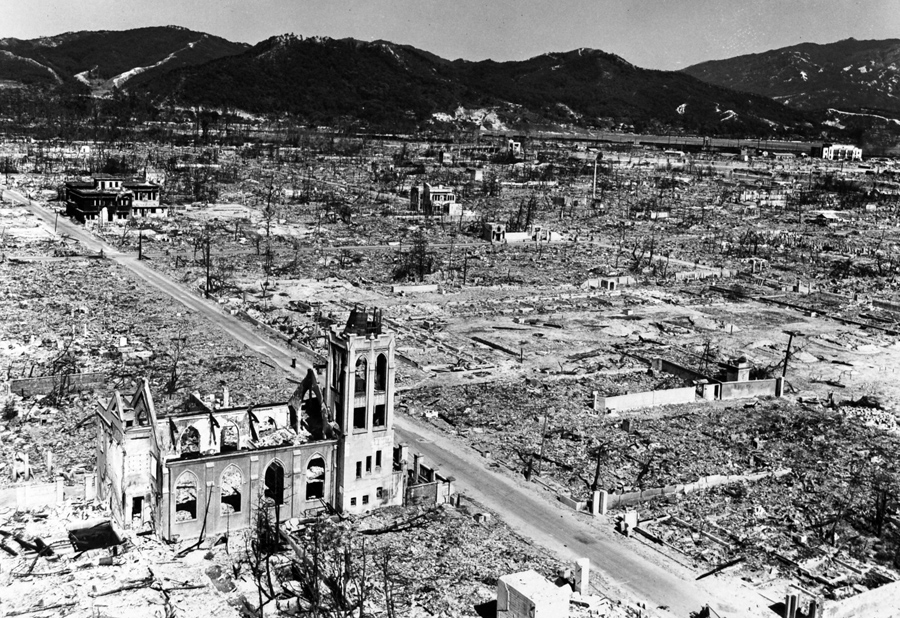
Today is the anniversary of the bombing of Hiroshima, Japan 73 years ago.  At the time of the bombing the city's population was approximately 340,00 - 350,000 people.  It is estimated that the bomb directly killed 70,000 people, including 20,000 Japanese combatants and 2,000 Korean slave laborers. By the end of the year, injury and radiation brought the total number of deaths to 90,000–166,000.  About 70% of the city's buildings were destroyed, and another 7% severely damaged.  This was the first time an atomic bomb was dropped on a city.  

Two days later another bomb was, this time on the city of Nagasaki.  At the time, the population of Nagasaki was estimated to be about 263,000 people -- 240,000 Japanese residents, 10,000 Korean residents, 2,500 conscripted Korean workers, 9,000 Japanese soldiers, 600 conscripted Chinese workers, and 400 Allied POWs  Less than a second after the detonation, the north of the city was destroyed and 35,000 people were killed.

On August 12, 2007 I preached this sermon at the congregation I was serving in Brewster, Massachusetts.  While many of the specifics are clearly of the time, I think the message still has relevance.


Opening Words:  The End and the Beginning


After every war
someone has to clean up.
Things won't
straighten themselves up, after all.

Someone has to push the rubble
to the sides of the road,
so the corpse-laden wagons
can pass.

Someone has to get mired
in scum and ashes,
sofa springs,
splintered glass,
and bloody rags.

Someone must drag in a girder
to prop up a wall.
Someone must glaze a window,
rehang a door.

Photogenic it's not,
and takes years.
All the cameras have left
for another war.

Again we'll need bridges
and new railway stations.
Sleeves will go ragged
from rolling them up.

Someone, broom in hand,
still recalls how it was.
Someone listens
and nods with unsevered head.
Yet others milling about
already find it dull.

From behind the bush
sometimes someone still unearths
rust-eaten arguments
and carries them to the garbage pile.

Those who knew
what was going on here
must give way to
those who know little.
And less than little.
And finally as little as nothing.

In the grass which has overgrown
causes and effects,
someone must be stretched out,
blade of grass in his mouth,
gazing at the clouds.


by Wislawa Szymborska 

(translated by Joanna Trzeciak)

Szymborska is a Polish poet and essayist.
She won the Nobel Prize for Literature in 1996. 


Reading:  “Ten-fifteen. The garden sprinklers whirled up in golden founts, filling the soft morning air with scatterings of brightness. The water pelted windowpanes, running down the charred west side where the house had been burned evenly free of its white paint. The entire west face of the house was black, save for five places. Here the silhouette in paint of a man mowing a lawn. Here, as in a photograph, a woman bent to pick flowers. Still farther over, their images burned on wood in one titantic instant, a small boy, hands flung into the air; higher up, the image of thrown ball, and opposite him a girl, hand raised to catch a ball which never came down. The five spots of paint- the man, the woman, the children, the ball- remained. The rest was a thin charcoaled layer.”

From “There Will Come Soft Rains” by Ray Bradbury.

* * *


At 8:14 there was a clear blue sky.  Birds flew in the morning sunshine.  Children laughed as they made their way to school.  People were doing tai chi and calisthenics in a city park.  There’d been a scare earlier in the morning but it seemed now that everything was okay.  Even when the world around you seems to be going crazy, days like this can make you feel alive and grateful.  The air is clean; the sun, warm.  You can forget the insanity.  On a day like this.  For a moment everything makes sense.
And in that moment—31,000 feet above the birds, and the children, and the men doing tai chi—the bomb doors on the Enola Gay opened and let loose a metal cylinder.  Ten feet long and two-and-a-half feet in diameter, it would change the world.  Not just for the people below or the people in the plane, but for every man, every woman, and every child who lived or ever would.
Forty-three seconds after it was flung loose that metal cylinder was 1,900 feet above the ground and it exploded with the force of 15,000 tons of TNT.  The birds burst into flame in mid-air.  So did combustible things like paper—even as far as a mile away.  Instantly.
The people in the park right below turned to ash.  Instantly.  A woman sitting on the steps of her bank, waiting for it to open, was reduced to a shadow.  You can see it today in the Hiroshima Peace Museum where they moved the steps so that she might not be forgotten.
Next came the blast wave.  Moving at a rate of two miles a second, people were blown from their feet, buildings were blown to the ground, trolleys and cars were blown from the roads.  Glass shattered twelve miles away.  A boy was blown through the windows of his house and across the street; his house collapsing behind him.  Within minutes, nine out of ten people half a mile or less from ground zero were dead.
And the numerous fires that erupted around Hiroshima soon joined together creating a monstrous firestorm that engulfed nearly four and half square miles of the city.  In its heart it is estimated that this beast reached temperatures of over seven thousand degrees.  (For comparison, the surface of the sun is just under ten thousand degrees.)  An interesting fact:  a postwar study showed that less than 4.5 percent of survivors of the bombing of Hiroshima suffered leg fractures.  That’s not, of course, because those injuries didn’t occur but because those who couldn’t walk died.
It’s estimated that somewhere around 100,000 people died as a direct result of the blast and the fires.  100,000 people. 
Yet these are just numbers:  15,000 tons of TNT.  Seven thousand degrees.  100,000 people dead.  60 million dead if you add in all those—military and civilians—who died during World War II. 
And wasn’t it World War I that was called “the war to end all wars”?
But it didn’t, did it?  And neither did World War II.  Or the Korean War.  Or Vietnam.
And now we’re embroiled in a war which we started without provocation, a “pre-emptive war” which it is clear that our leaders lied us into launching.  Over 135,000 people have died, and our country alone has spent roughly $451,345,000,000 on the war—that’s as of 9:00 this morning when I checked a running total on the web.  The money we’ve spent on the war in Iraq could have paid for 59,780,739 kids to attend Head Start, nationwide, for a year.  Or it could have built 114,832 additional units of affordable housing in Massachusetts.  Or it could have hired 7,170 new public school teachers in Barnstable County alone.  So, what is the cost of this war?
Yet even more important than that is the question, “what is the cost of war?”  Any war?  What do we loose—not just how many lives are lost but how much Life is lost—when nations take up arms against each other? 
How is it possible that we haven’t stopped fighting yet?  After Hiroshima, Nagasaki, Dresden, Pearl Harbor, the Congo, Korea, Rwanda, Cambodia, Afghanistan, Sarajevo, Somalia, Northern Ireland, New York City, Bagdad—how can we still be slaughtering one another?  It’s been over thirty years since Edwin Starr shouted out, “War.  What is it good for?”  and answered himself, “Absolutely nothin’.”  How is it that we haven’t learned?
Maybe it’s because we keep talking about numbers.  Joseph Stalin said that the death of one person is a tragedy, while the death of millions is a statistic. But there are no statistics.  There is no such thing as “collateral damage.”  There are only people—mothers, fathers, sons, daughters, grandparents, grandchildren, neighbors, friends.  Strangers, even.  Enemies, even.  But no numbers.  Numbers don’t exist; only people do.  Until they don’t anymore.  Until they become shadows in a museum.
Or maybe it’s because we keep thinking that we can fight our way to peace, that the problem is some bad people over there and if we can just beat them into submission peace will prevail.  We believe that it’s in talking tough, acting tough, that we protect the peace.  We’re told—and many believe—that the best defense is a good offense and that while might might not make right, might in the hands of the good guys is there to be used.
Or maybe we’re still warring even with the mushroom cloud in our memories because we haven’t really explored an alternative.  One thing that gives me hope is the legislation currently before the U.S. House of Representatives to create a United States Department of Peace.  This legislation would:
l     Create a cabinet level position—the Secretary of Peace—who would be equal to the Secretary of Defense and the Secretary of State and would advise the president on peacebuilding needs, strategies, and tactics for use both domestically and internationally.
l     It would create a Peace Academy, on a par with our military service academies, which will build a world-class faculty of peacebuilding experts who would be able to analyze peacebuilding strategies at the highest level, advise other branches of government, and facilitate the training of peacebuilders for domestic and international service. 
l     This legislation calls for funds to create and expand proven domestic peace building programs in our communities.

In short, the Department of Peace would be dedicated to discovering, developing, and deploying methods to meaningfully prevent conditions of conflict before violence erupts—both abroad and at home.

Now, of course, lots of individuals and groups think that that’s just a nutty idea.  But peace will never be found at the end of the barrel of a gun.  Remember the quotations from the first of our peace services last year:
l     If we have no peace, it is because we have forgotten that we belong to each other.
~ Mother Teresa
l     There is no way to peace. Peace is the way.  ~ A.J. Muste
l     Peace is not merely the absence of war. It is also a state of mind. Lasting peace can come only to peaceful people.  ~ Jawaharlal Nehru
l     Peace is more important than all justice; and peace was not made for the sake of justice, but justice for the sake of peace.  ~ Martin Luther
I think that it was Einstein who, after seeing the devastation of the atomic bomb, said that humankind had progressed so far technologically that we now needed an evolution of consciousness if we hoped to survive.  And Al Gore, in his film An Inconvenient Truth, made the point that when old habits—and he used the example of humanity’s penchant for warfare—are joined to new technology—and here he showed a picture of an atomic mushroom cloud—the results can be devastating and so we have to somehow learn to break our old habits.
This week saw the sixty-second anniversary of the bombings of Hiroshima and Nagasaki.  During the service I’ve had this metronome beating out as fast as it can, and if each beat represents one person—one mother, father, husband, wife, sister, brother, daughter, son who died from the immediate effects of the bombing on August 6th—then when our hour is up . . . at this rate . . .  we will be halfway through remembering them all.
But it’s not about numbers, and it’s not even about what has been done.  It’s about people, and about what we can do.  I’d like to see First Parish take its place as a leader in this work for peace.  We have strongly staked our place as an open, anti-oppression congregation.  I would like to see us take and equally solid stand as a place of peace. 
We are known for stands against the demonization of people because of their race, or their gender expression, or their sexual orientation; I would like us to become known for standing against the demonization of people because of their nationality or their ideology.  We are engaged with the work of ending violence in the home, let’s expand that to our world home.  Let’s build on the work we’re already doing—which so many of us as individuals are already involved in—and make peace one of our priorities.
Protests, vigils, letter writing, hosting community forums, working on legislation, running for office . . . we can do so many things.
I’ll end with one of my favorite quotes.  Edward Everett Hale.  “I am only one, but still I am one.  I cannot do everything, but still I can do something.  And because I cannot do everything, I must not fail to do the something that I can.”


Closing Words:  Every Day


War is no longer declared,
only continued. The monstrous
has become everyday. The hero
stays away from battle. The weak
have gone to the front.
The uniform of the day is patience,
its medal the pitiful star of hope above the heart.
The medal is awarded
when nothing more happens,
when the artillery falls silent,
when the enemy has grown invisible
and the shadow of eternal armament
covers the sky.
It is awarded
for desertion of the flag,
for bravery in the face of friends,
for the betrayal of unworthy secrets
and the disregard
of every command.

by Ingeborg Bachmann, Austiran poet