Showing posts with label peace. Show all posts

Monday, May 06, 2019

On Justice, Truth, and Peace


This is the text of the reflections I offered on Sunday, May 5, 2019 in the congregation I serve here in Charlottesville, Virginia.

Rabban Simeon ben Gamliel whose words are at the heart of the piece the choir just sang, was a Jewish sage and leader who lived a little less than 2,100 years ago. Rav Muna, the other rabbi quoted in the choral piece, was one of the two rabbi who edited an early version of the Talmud, known as “The Talmud of the Land of Israel.”  Commenting on the teaching of ben Gamliel that “on justice, truth, and peace the whole world stands,” Rav Muna said something that Amy Bernon didn’t include in her song.  He said that in truth, those three things are not three separate things, wholly distinct from one another.  Rather, he taught, those three things are really only one thing.  That’s why, as she quoted, “where justice is done, truth is done, and peace is made.” 
This put me in mind of another saying that has this same interlocking progressive structure.  It’s actually from our Unitarian kin in Transylvania.  I imagine that our friend the Rev. István Török leads the members of our partner congregation in Olteviz in saying this with some regularity:
Hol hit—ott szeretet
Hol szeretet—ott béke
Hol béke—ott áldás
Hol áldás—ott Isten
Hol Isten—ott szükseg nincen
Elizabeth North, the Director of Music at our congregation in Concord, Massachusetts and a Unitarian Universalist composer extraordinaire, set this text to music.  It’s #1043 in the teal hymnal. (I’ll note that Beth took a little liberty with the last line):
Where there is faith there is love
Where there is love there is peace
Where there is peace there is blessing
Where there is blessing there is God
Where there is God there, there is no need.
Let’s sing that together …
Do you see the pattern?  Where justice is done, truth is done – they’re one and the same.  And where justice and truth are, peace is made.  If faith exists, then hope exists, and love exists, and peace exists, and blessings abound, and God – however you conceive of that Sacred Something, that Unlimited Love that undergirds all that is – where that is, we have all we need (which is the original last line).
For the longest time I’ve had a magnet on my refrigerator with words taken from the writings of Lau-Tzu.  It also has this same understanding of the simultaneity, the essential, fundamental equivalency of what might seem to be different things. I’ll bet that a number of you know it:
“If there is to be peace in the world,
There must be peace in the nations.
If there is to be peace in the nations,
There must be peace in the cities.
If there is to be peace in the cities,
There must be peace between neighbors.
If there is to be peace between neighbors,
There must be peace in the home.
If there is to be peace in the home,
There must be peace in the heart.” 
I did a lot of research for these Reflections – facts and figures, Jewish history, world history, current events …  I’ve thrown all that out.  (Although I will post that version on my blog next week for those of you who are into that sort of thing.)  I threw all of that because as I wrote I kept hearing a little voice in my head.  It was our Associate Minister, Rev. Alex.  Her voice was encouraging me not to tell you things you already know – about how if we look around us there seems to be so little evidence of justice, truth, and peace in our world today.  “They know that,” she said in my head.  “They’re already living with that, living in that.  What they need is to have some thoughts about what to do with that.”  And she’s right.

What do we do when we live in a society, and increasingly a world, where injustice can seem to be the norm, where truth appears to be under attack, and where peace is hard to find?  If on these three things the whole word stands, what do we do when those supports are looking increasingly unstable? 
Well … if justice, truth, and peace are not three separate things but only one thing; and if faith, love, peace, blessing, and that Holy Whole in which “we live and move and have our being” co-exist; then for there to be any of them in the world, they must first be alive in our hearts.

So … how do we bring these needful things to life and nurture them in ourselves?  We cultivate them.  We work at it.  Sorry, but there’s no other way.  No shortcut.  We have to work at it.  We make choices day-in and day-out, responding to the situations we find ourselves in rather than reacting to them out of our cultural conditioning.  We ask ourselves again and again, “What is the truth here?  What does justice look like in this encounter?  What would Peace do?”  (WWPD)

This morning I’m going to suggest three things, three ways that we can do the work of developing peace in our hearts.  Although justice, and truth, and faith, and love, and all of those things are needed in our world, I think peace provides a good model of how to respond to our own heart’s need of them. 

So … three things we can do to cultivate, to develop, to strengthen peace in our hearts:
First, we can put ourselves into direct contact with beauty.   We’re surround by beauty here right now – after the service wander around the sanctuary and take in Marissa Minnerly’s paintings.  On the drive, or the walk home, grey though the sky is today, look at the flowers you pass.  Really notice them, how their colors pop.  Let their beauty into you.  Go out into the woods, get onto a river or lake, drink deep the natural world.  Look into the eyes of a loved one, listen to their voice, reminisce about the good times you’ve had and about all the good times to come (as Willie Nelson says in one of his songs).  For that matter, listen to music.  Music is a great way to put yourself in the presence of beauty.

I have to pause here a moment to express my deepest appreciation to the choir, to Scott, to James.  I often hear clergy colleagues bemoaning the fact that they so rarely get to worship themselves, because they’re so often facilitating worship experiences for others.  I tell them that I get to worship every single Sunday.  St. Francis of Assisi is remembered as saying to his companions, “Preach always.  When necessary, use words.”  Each and every Sunday I get to – we get to – hear powerful preaching and profound sounds of prayer.  I’ll let you in on a secret:  when Scott plays a Prelude, or James plays the Musical Meditation, or whenever the service switches from words to music, I forget all about all y’all.  I don’t give you another thought.  I just open myself and let the beauty of the music wash over me, flow through me, and I revel in the mastery we’re experiencing.  That is worship here for me, and even though I think that from time to time the preacher has something worth hearing I know that many of you feel as I do. 

I do also want to put in a good word for words, though.  I was brought up by parents who shared with their kids a love of words, and to this day a well-crafted sentence brings me joy.  A few years back my friend and mentor, the Rev. Gary Smith, served on the panel that interviewed candidates for the position of Professor of Homiletics at the Starr King School for the Ministry, our seminary out in Berkley, California.  He told me that there were two questions he asked each prospective professor:  who is your favorite poet, and what was the last novel you read?  He asked these not only because if you’re going to make your living with words – which we preachers do – then you should regularly engage with the work of others who share the craft.  He also thought it important because both poetry and fiction are acts of imagination, of taking the world as it is and opening it up, exploring it in new ways, creating something revelatory.  Poetry and (good) fiction are beautiful in a very deep sense of that word.  And they are avenues for that direct contact with beauty that can help us cultivate peace in our hearts.

My second suggestion is to regularly do things that fill us up.  Modern life can be so … draining.  It can take so much out of us, the day-in day-outness of our lives.  We can go for long periods of time – for some of us extremely long periods of time – without having the opportunity to replenish our souls, our spirits.  The things we’re doing may be really important, even enjoyable, yet the often pressured pace depletes the peace we, and the world, so desperately need.  For there to be peace in the world there must be peace in the heart. 

The concept of “extroverts” and “introverts” is often misunderstood, seeing “extroverts” as people who like people and “introverts” as people who … prefer their cats.  It’s not that at all.  There are a great many people who are introverts who really like being around people, and extroverts who enjoy being alone.  The real differences is that an introvert’s spiritual/emotional battery is refilled by solitude, while the inverse is true of extroverts – they get charged by being with others.

So for those of us who are introverts, we need to find time, make time, to be alone, and to be alone with nothing to do.  No laundry, no shopping for groceries, no making of lists.  Of course, we can do those things if doing them feeds us.  The point here is, as one of my spiritual teachers put it, “don’t do anything that you have to do, that you feel obligated to do.”  So make time for this solitary not-doing regularly.  Not every once-in-a-while when the opportunity presents itself.  Regularly.  Frequently.  We should schedule it in our day timer.

For those of us who are extroverts, we need to schedule time to hang out with people we enjoy.  And I don’t mean those social events we kind of have to go to, parties (or meetings) we feel obliged to attend, those gatherings that have some kind of purpose to them.  I mean just hanging out for the sake of hanging out.

Making the time and space for those things that fill our spirits, along with putting ourselves, regularly, into direct contact with beauty – these things can help us to develop the peace in our hearts that is essential if we’re to survive these times we’re in.

One last thing.  (And given my background as a magician, juggler, fire-eater, escape artist, and clown you should probably be expecting this one.)  Play.  “Life’s too mysterious,” a greeting card said, “don’t take it serious.”  Find a young child and get down on the floor and play with them.  Heck, get down on the floor and play even if there’s no child anywhere around.  From the floor there’s an entirely different perspective on things.  Go to kids movies – superhero films come immediately to my mind, of course, but Toy Story 4 and The Secret Life of Pets 2 are coming out soon.  Do something silly because it’s silly.  A therapist I know (who I consider a rabbi, a wise sage) told me once that he’d like to write a book about how our lives could be so much healthier if we’d try to laugh, really laugh, full-throated, no-holds-barred laugh at least once a day.  He said that he worked in a group setting he made it a practice for the staff, and that it made all the difference.  (When I told him about how much our staff laughs when we’re together he was impressed, even envious, and said that we must be doing something right.)

So .. to cultivate peace in our hearts, in our lives, we can ourselves into direct contact with whatever we find to as expressions of Beauty – wherever we find them.  We can take time, make time, to do what (re)fills our spirit, taking care to avoid doing anything that we feel like we have to do, are supposed to do, feel obligated to do.  And we can play, be silly, laugh – early and often.  These three things can help us to create peace in our hearts without which there cannot be peace in the home, among neighbors, in the cities, in the nations, or in the world; without which the world doesn’t have a leg to stand on.

Amen.


Pax tecum,

RevWik


Monday, August 06, 2018

8-15-8-6-45


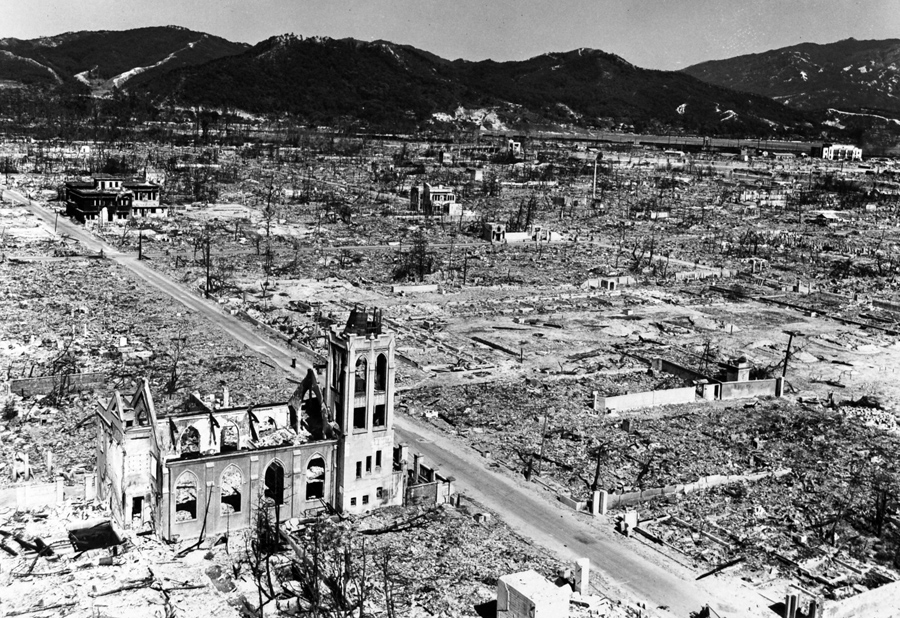
Today is the anniversary of the bombing of Hiroshima, Japan 73 years ago.  At the time of the bombing the city's population was approximately 340,00 - 350,000 people.  It is estimated that the bomb directly killed 70,000 people, including 20,000 Japanese combatants and 2,000 Korean slave laborers. By the end of the year, injury and radiation brought the total number of deaths to 90,000–166,000.  About 70% of the city's buildings were destroyed, and another 7% severely damaged.  This was the first time an atomic bomb was dropped on a city.  

Two days later another bomb was, this time on the city of Nagasaki.  At the time, the population of Nagasaki was estimated to be about 263,000 people -- 240,000 Japanese residents, 10,000 Korean residents, 2,500 conscripted Korean workers, 9,000 Japanese soldiers, 600 conscripted Chinese workers, and 400 Allied POWs  Less than a second after the detonation, the north of the city was destroyed and 35,000 people were killed.

On August 12, 2007 I preached this sermon at the congregation I was serving in Brewster, Massachusetts.  While many of the specifics are clearly of the time, I think the message still has relevance.


Opening Words:  The End and the Beginning


After every war
someone has to clean up.
Things won't
straighten themselves up, after all.

Someone has to push the rubble
to the sides of the road,
so the corpse-laden wagons
can pass.

Someone has to get mired
in scum and ashes,
sofa springs,
splintered glass,
and bloody rags.

Someone must drag in a girder
to prop up a wall.
Someone must glaze a window,
rehang a door.

Photogenic it's not,
and takes years.
All the cameras have left
for another war.

Again we'll need bridges
and new railway stations.
Sleeves will go ragged
from rolling them up.

Someone, broom in hand,
still recalls how it was.
Someone listens
and nods with unsevered head.
Yet others milling about
already find it dull.

From behind the bush
sometimes someone still unearths
rust-eaten arguments
and carries them to the garbage pile.

Those who knew
what was going on here
must give way to
those who know little.
And less than little.
And finally as little as nothing.

In the grass which has overgrown
causes and effects,
someone must be stretched out,
blade of grass in his mouth,
gazing at the clouds.


by Wislawa Szymborska 

(translated by Joanna Trzeciak)

Szymborska is a Polish poet and essayist.
She won the Nobel Prize for Literature in 1996. 


Reading:  “Ten-fifteen. The garden sprinklers whirled up in golden founts, filling the soft morning air with scatterings of brightness. The water pelted windowpanes, running down the charred west side where the house had been burned evenly free of its white paint. The entire west face of the house was black, save for five places. Here the silhouette in paint of a man mowing a lawn. Here, as in a photograph, a woman bent to pick flowers. Still farther over, their images burned on wood in one titantic instant, a small boy, hands flung into the air; higher up, the image of thrown ball, and opposite him a girl, hand raised to catch a ball which never came down. The five spots of paint- the man, the woman, the children, the ball- remained. The rest was a thin charcoaled layer.”

From “There Will Come Soft Rains” by Ray Bradbury.

* * *


At 8:14 there was a clear blue sky.  Birds flew in the morning sunshine.  Children laughed as they made their way to school.  People were doing tai chi and calisthenics in a city park.  There’d been a scare earlier in the morning but it seemed now that everything was okay.  Even when the world around you seems to be going crazy, days like this can make you feel alive and grateful.  The air is clean; the sun, warm.  You can forget the insanity.  On a day like this.  For a moment everything makes sense.
And in that moment—31,000 feet above the birds, and the children, and the men doing tai chi—the bomb doors on the Enola Gay opened and let loose a metal cylinder.  Ten feet long and two-and-a-half feet in diameter, it would change the world.  Not just for the people below or the people in the plane, but for every man, every woman, and every child who lived or ever would.
Forty-three seconds after it was flung loose that metal cylinder was 1,900 feet above the ground and it exploded with the force of 15,000 tons of TNT.  The birds burst into flame in mid-air.  So did combustible things like paper—even as far as a mile away.  Instantly.
The people in the park right below turned to ash.  Instantly.  A woman sitting on the steps of her bank, waiting for it to open, was reduced to a shadow.  You can see it today in the Hiroshima Peace Museum where they moved the steps so that she might not be forgotten.
Next came the blast wave.  Moving at a rate of two miles a second, people were blown from their feet, buildings were blown to the ground, trolleys and cars were blown from the roads.  Glass shattered twelve miles away.  A boy was blown through the windows of his house and across the street; his house collapsing behind him.  Within minutes, nine out of ten people half a mile or less from ground zero were dead.
And the numerous fires that erupted around Hiroshima soon joined together creating a monstrous firestorm that engulfed nearly four and half square miles of the city.  In its heart it is estimated that this beast reached temperatures of over seven thousand degrees.  (For comparison, the surface of the sun is just under ten thousand degrees.)  An interesting fact:  a postwar study showed that less than 4.5 percent of survivors of the bombing of Hiroshima suffered leg fractures.  That’s not, of course, because those injuries didn’t occur but because those who couldn’t walk died.
It’s estimated that somewhere around 100,000 people died as a direct result of the blast and the fires.  100,000 people. 
Yet these are just numbers:  15,000 tons of TNT.  Seven thousand degrees.  100,000 people dead.  60 million dead if you add in all those—military and civilians—who died during World War II. 
And wasn’t it World War I that was called “the war to end all wars”?
But it didn’t, did it?  And neither did World War II.  Or the Korean War.  Or Vietnam.
And now we’re embroiled in a war which we started without provocation, a “pre-emptive war” which it is clear that our leaders lied us into launching.  Over 135,000 people have died, and our country alone has spent roughly $451,345,000,000 on the war—that’s as of 9:00 this morning when I checked a running total on the web.  The money we’ve spent on the war in Iraq could have paid for 59,780,739 kids to attend Head Start, nationwide, for a year.  Or it could have built 114,832 additional units of affordable housing in Massachusetts.  Or it could have hired 7,170 new public school teachers in Barnstable County alone.  So, what is the cost of this war?
Yet even more important than that is the question, “what is the cost of war?”  Any war?  What do we loose—not just how many lives are lost but how much Life is lost—when nations take up arms against each other? 
How is it possible that we haven’t stopped fighting yet?  After Hiroshima, Nagasaki, Dresden, Pearl Harbor, the Congo, Korea, Rwanda, Cambodia, Afghanistan, Sarajevo, Somalia, Northern Ireland, New York City, Bagdad—how can we still be slaughtering one another?  It’s been over thirty years since Edwin Starr shouted out, “War.  What is it good for?”  and answered himself, “Absolutely nothin’.”  How is it that we haven’t learned?
Maybe it’s because we keep talking about numbers.  Joseph Stalin said that the death of one person is a tragedy, while the death of millions is a statistic. But there are no statistics.  There is no such thing as “collateral damage.”  There are only people—mothers, fathers, sons, daughters, grandparents, grandchildren, neighbors, friends.  Strangers, even.  Enemies, even.  But no numbers.  Numbers don’t exist; only people do.  Until they don’t anymore.  Until they become shadows in a museum.
Or maybe it’s because we keep thinking that we can fight our way to peace, that the problem is some bad people over there and if we can just beat them into submission peace will prevail.  We believe that it’s in talking tough, acting tough, that we protect the peace.  We’re told—and many believe—that the best defense is a good offense and that while might might not make right, might in the hands of the good guys is there to be used.
Or maybe we’re still warring even with the mushroom cloud in our memories because we haven’t really explored an alternative.  One thing that gives me hope is the legislation currently before the U.S. House of Representatives to create a United States Department of Peace.  This legislation would:
l     Create a cabinet level position—the Secretary of Peace—who would be equal to the Secretary of Defense and the Secretary of State and would advise the president on peacebuilding needs, strategies, and tactics for use both domestically and internationally.
l     It would create a Peace Academy, on a par with our military service academies, which will build a world-class faculty of peacebuilding experts who would be able to analyze peacebuilding strategies at the highest level, advise other branches of government, and facilitate the training of peacebuilders for domestic and international service. 
l     This legislation calls for funds to create and expand proven domestic peace building programs in our communities.

In short, the Department of Peace would be dedicated to discovering, developing, and deploying methods to meaningfully prevent conditions of conflict before violence erupts—both abroad and at home.

Now, of course, lots of individuals and groups think that that’s just a nutty idea.  But peace will never be found at the end of the barrel of a gun.  Remember the quotations from the first of our peace services last year:
l     If we have no peace, it is because we have forgotten that we belong to each other.
~ Mother Teresa
l     There is no way to peace. Peace is the way.  ~ A.J. Muste
l     Peace is not merely the absence of war. It is also a state of mind. Lasting peace can come only to peaceful people.  ~ Jawaharlal Nehru
l     Peace is more important than all justice; and peace was not made for the sake of justice, but justice for the sake of peace.  ~ Martin Luther
I think that it was Einstein who, after seeing the devastation of the atomic bomb, said that humankind had progressed so far technologically that we now needed an evolution of consciousness if we hoped to survive.  And Al Gore, in his film An Inconvenient Truth, made the point that when old habits—and he used the example of humanity’s penchant for warfare—are joined to new technology—and here he showed a picture of an atomic mushroom cloud—the results can be devastating and so we have to somehow learn to break our old habits.
This week saw the sixty-second anniversary of the bombings of Hiroshima and Nagasaki.  During the service I’ve had this metronome beating out as fast as it can, and if each beat represents one person—one mother, father, husband, wife, sister, brother, daughter, son who died from the immediate effects of the bombing on August 6th—then when our hour is up . . . at this rate . . .  we will be halfway through remembering them all.
But it’s not about numbers, and it’s not even about what has been done.  It’s about people, and about what we can do.  I’d like to see First Parish take its place as a leader in this work for peace.  We have strongly staked our place as an open, anti-oppression congregation.  I would like to see us take and equally solid stand as a place of peace. 
We are known for stands against the demonization of people because of their race, or their gender expression, or their sexual orientation; I would like us to become known for standing against the demonization of people because of their nationality or their ideology.  We are engaged with the work of ending violence in the home, let’s expand that to our world home.  Let’s build on the work we’re already doing—which so many of us as individuals are already involved in—and make peace one of our priorities.
Protests, vigils, letter writing, hosting community forums, working on legislation, running for office . . . we can do so many things.
I’ll end with one of my favorite quotes.  Edward Everett Hale.  “I am only one, but still I am one.  I cannot do everything, but still I can do something.  And because I cannot do everything, I must not fail to do the something that I can.”


Closing Words:  Every Day


War is no longer declared,
only continued. The monstrous
has become everyday. The hero
stays away from battle. The weak
have gone to the front.
The uniform of the day is patience,
its medal the pitiful star of hope above the heart.
The medal is awarded
when nothing more happens,
when the artillery falls silent,
when the enemy has grown invisible
and the shadow of eternal armament
covers the sky.
It is awarded
for desertion of the flag,
for bravery in the face of friends,
for the betrayal of unworthy secrets
and the disregard
of every command.

by Ingeborg Bachmann, Austiran poet


Monday, July 02, 2018

A Place of Peace

This is the text of the reflections I offered at the congregation I serve here in Charlottesville, Virginia on Sunday, July 1, 2018.  I wanted the second half to be less consciously conceptual and more a free flowing of spirit, so this is a reconstruction of what those who were here heard.


Opening Words:
The abbot of a provincial monastery was in something of a tizzy, because the abbot of his school’s main temple was coming for a visit, and he wanted everything to be just perfect.  He had set his students to polishing every bit of wood, and brass, and gold, and to seek out every single dust bunny.  He, himself, attended to the grounds.

An old monk, a recognized Zen master who had retired to this monastery watched as the young abbot spent several hours raking leaves from all of the walking trails.  The abbot wanted the woods to exude quiet, and peace, and … well … perfection.  He imagined walking these clear, unobstructed paths with his honored guest, just as he strove to lead the monks under his care over the clear, unobstructed paths of the dharma.

As I said, the old monk stood watching the abbot at his labors the whole time.  When he was finished, the abbot came to the monk, and with pride in his accomplishment the young man asked the old man what he thought.  “Well … ,” the old monk said, “I have to say, you’ve certainly worked very, very hard at this, and it’s almost right. 

The abbot replied, somewhat anxiously, “Please, tell me what I have to do to make it perfect.”  “I’d rather show you,” the old master said.  He took the rake, and spent the next hour putting the leaves back on the path.  “There,” he said when he was done. “Now it’s perfect.”

He gave the rake to the startled abbot, and walked away without another word.


Sermon:
One hour a day.  One day a week.  One week a year. 

One hour a day.  One day a week.  One week a year. 

I want you to hold on to that formula.  We’ll come back to it later.  (I’ll come back to that story about the monks and the leaves in a bit, too.)

Most Sundays I note that the heart of our sanctuary service is not the sermon, or the music, (or the offering!), it’s what we call the time of “Going Deeper.”  Our lives can be so full, and so hectic, I say (as if it would be news to any of us).  Every religious tradition I know anything about exhorts us to seek, to find, or to create spaces and places in our lives where we are not overcome by the cacophony of life; where our hearts and our minds can find respite; where our souls can be silent and calm. 
In the book of 1 Kings in the Hebrews Scriptures the story is told of the prophet Elijah who asks to see G_d.  After all manner of images pass him by – a strong wind that can destroy a mountain, an earthquake, an all-consuming fire – after all of these things pass him by, Elijah finally recognizes his G_d in what is usually translated as, “a still, small voice.”  (It is alternately rendered, “a gentle whisper,” or, my favorite, “the voice of quiet stillness.”)

We have, hopefully, each of us had our own experiences of such sacred silence, times where the world grew quiet … and so did we.  Spiritual practices such as meditation and contemplative prayer can be understood to be, at the very least, about learning to create and cultivate such peace in a world, in our lives, which are most often anything but.

We need such times.  We need such places.  We need such experiences.  Because just as we have been learning how vitally important sleep is to our bodily and mental health, so too is such peace vitally important to our spiritual health. 

The Unitarian Transcendentalist Ralph Waldo Emerson (who, a colleague once described as, “wash[ing] out of the ministry early”) had more than a little to say about sacred space.  In his essay Nature, St. Ralph described an experience he had in nature, that has been often quoted (although here I’m going to read a little more than is usually used):

Crossing a bare common, in snow puddles, at twilight, under a clouded sky, without having in my thoughts any occurrence of special good fortune, I have enjoyed a perfect exhilaration. I am glad to the brink of fear.  In the woods, too, a [person casts off [their] years, as the snake [its] slough, and at what period soever of life is always a child.  In the woods, is perpetual youth.  Within these plantations of God, a decorum and sanctity reign, a perennial festival is dressed, and the guest sees not how [they] should tire of them in a thousand ears.  In the woods, we return to reason and faith.  There I feel that nothing can befall me in life, -- no disgrace, no calamity, (leaving me my eyes), which nature cannot repair.  Standing on the bare ground – my head bathed by the blithe air, and uplifted into infinite space – all mean egotism vanishes.  I become a transparent eye-ball.  I am nothing.  I see all.  The currents of the Universal Being circulate through me; I am part or particle of God.

The Austrian poet René Karl Wilhelm Johann Josef Maria Rilke, better and more simply known as Rainer Maria Rilke had similar thoughts about the ocean:

"When anxious, uneasy and bad thoughts come, I go to the sea, and the sea drowns them out with its great wide sounds, cleanses me with its noise, and imposes a rhythm upon everything in me that is bewildered and confused."

How many of us have had such experiences?  How many of us – in the woods, by the ocean, at the bank of a river, on a trail, in our gardens – how many of us have found this kind of sacred space and felt its healing balm (at least some of the times)?  I have always loved the power of an incoming storm, when the temperature drops and the winds pick up, and the sky changes color and, almost, texture.  (I’ve read that the Persian poet Khalil Gibran did too – going up to the roof of his apartment in New York City whenever a really powerful storm was coming.)  Like Emerson, I experience “a perfect exhilaration […] am glad to the brink of fear,” and find my worries and woes dropping away.

All of this is why our time of “Going Deeper” is the hub, the heart of what we do here week after week.  This time we set aside is, for some of us, the only time when we can slow down long enough to have even a taste of this kind of stillness.  And for some of us – no doubt for many of us – this place is as important as this time.  We come here, to this sanctuary, as, if you will, to an in-town forest or ocean.  We come here to seek a stillness, to find a stillness, so that that stillness can carry us through the rest of our week.

The Unitarian Universalist pastor and preacher Rev. Phillip Hewett described this seeking in words that are often used as Opening Words in UU congregations (it’s #440 in the back of our hymnals):

“From the fragmented world of our everyday lives we gather together in search of wholeness.  By many cares and preoccupations, by diverse and selfish aims are we separated from one another and divided within ourselves.”

Another story.  (And I haven’t forgotten that earlier story about the monks and the leaves, nor the formula with which I began – one hour a day; one day a week; one week a year.  I hope you haven’t yet either, and if you did I’ve just reminded you.)

I’ve mentioned before that when I was in my 20s I had the wonderful opportunity to spend two months in Japan working with the Kanjiyama Mime troupe.  This was in the midst of the twenty or so year period in which I followed the Zen Buddhist path, so although my work in Japan was centered mostly in and around Tokyo, I simply had to make a side trip to Kyoto, which was the Imperial capital of Japan for over 1,000 years.  It’s also been called “the city of temples,” because of its 1,600 Buddhist temples and 400 Shinto shrines.

I visited several Buddhist temples while I was there, particularly those with the justly famed gardens of stone and raked sand.  And I have to say, when I walked onto the temple grounds – and this was true of all of the temples I visited – I was overwhelmed with a sense of peace.  It was nearly palpable, and I felt myself infused with it.  Just being there quieted my mind and stilled my soul.  It was powerful, and an experience I hope I never forget (no matter how much else I may come to forget).
And this pervasive and palpable peace was perhaps nowhere more present than in the zendo.  These beautiful, spare spaces seemed filled with the energy generated by the monks who meditated there day after day, week after week, years upon years, over centuries and centuries.  It seemed to me that these halls had been infused by the peace of its monks, just as it held the fragrance of all of the incense that had been burned there.

At one of the temples the monk who was walking me around brought me outside the back of its zendo.  The meditation hall had been built at the base of a cliff, and there was a place where a small waterfall had carved a channel in the rock.  Ice cold water from a mountain stream above still fell, as it had for centuries.  At the base of this channel there was a somewhat circular, somewhat flat rock … about the size of a meditation cushion, actually.  And the monk told me that the most advanced students would sometimes leave the zendo during the time of meditation, that they would get off their cushions and come out here.  They would leave the peace and stillness of the zendo and come out here to continue their zazen practice— here, on that rock, under that icy shower.  He invited me to touch it, and even the brief period it poured over my hand was quite literally bone chilling.  And there were monks who choose to practice here under this freezing flow, rather than in the warmth and peace of the meditation hall.

Since I posted the Black Lives Matter sign on the wall behind this pulpit, I have heard from some of you who’ve said that it disrupted, and for some even destroyed, the feeling of peace you had in this hall, and which you sought still.  For some it’s the “garish” colors, discordant with soft blue of the wall.  Some felt it to be an intrusion of the outer world into this inner space, an imposition of the political – and the divisively political at that – into this place of peace.  “I used to look up at the altar throughout the service” someone said to me, “and it would allow me to let everything go.”  This person continued, “Now I can’t.  Whenever I look toward the altar I see that sign, and I can no longer get away from anything … even for just this one hour.”

I would note that this isn’t everyone’s experience.  I have also heard from some of you who find the presence of this sign a powerfully positive thing.  Many – not all, but many – people of color, and perhaps especially those who are new to the congregation, who are checking it out, have said that seeing that sign not only outside of our building, but inside it as well, has made them feel truly welcomed and safe in a predominantly white faith community … for the first time.  “You see me,” they’ve said.  “And you care enough about me to say that explicitly, here, in this sacred space, even though it must cause some of you discomfort to do so.”  As Unitarian Universalists – particularly as Unitarian Universalists committed to the vision of true Beloved Community, that is truly multigenerational and multicultural and committed to the dismantling of racism and the systems and structures of oppression of all kinds – as Unitarian Universalists we know that having our needs met is not the ultimate measure of our success.  Rather, it’s to be a people who know that what matters most is our collective needs, the needs of our whole community, and that means sometimes setting aside my own needs for the sake of someone else’s.  This is one of my reasons for keeping the sign where it is – while some of us are discomforted by its presence, others (and not just people of color, but some of us who identify as white, as well) are more comfortable because it’s there.

I’ve also said, over the years, that if those of us who identify (or are identified as) white are really committed to the overthrow of the deeply and fundamentally racist culture that is U.S. culture, if we’re really committed to this work, then we are going to have to change.  We are going to have to be uncomfortable, because it is uncomfortable work to let of what we’ve known, and learn to see the world through new eyes.  Yesterday, at the Families Belong Together rally downtown, we were reminded by one of the speakers that as outraged as we are by the separation of immigrant families today, it’s been happening in our country to brown and black families since the founding of the nation – African families, native families, the families of anyone deemed to be “Other” have had their families split up as a deterrent .. a deterrent to even thinking about fighting back against their oppression and their oppressors.  This makes a lot of white folk really uncomfortable, as we want to believe that this kind of behavior is an aberration, and it’s tremendously disconcerting and disorienting to discover that it’s actually been a part of the fabric of our culture from the beginning.  

I’ve preached this need for those of us who identify as white to “get comfortable with being uncomfortable,” to lean into the pain that brings with it, and to realize that our assertion, our assumption, that we can and should be comfortable is a piece of privilege not shared equally.  Black and brown people – like women, those who identify as part of LGBTQI communities, Muslims, and everyone who’s been historically, and still are, marginalized – have had to get comfortable with being uncomfortable because that’s a part of their daily experience.  I’ve preached this, and this message has been greeted with applause and praise for my “courage” and willingness to “say what has to be said.”  The presence of this sign is one way to remind us of these truths.

My two Buddhist stories are another way of understanding what the presence of this sign, in this place, is all about.  It is easy to find peace in peaceful places.  It is easy to be still when there is stillness all around.  It is easy, with apologies to Kipling, for us to “keep our heads when all about us are keeping theirs.”  But try meditating under a shower of ice cold mountain water.  Try finding a clear path when it’s obscured by leaves.  Try looking at the altar and letting everything go when out of the corner of your eye you see a reminder of the pain and the struggle in our world.

I can imagine that some of you are experiencing these reflections as being more than a little … defensive.  And I can imagine that some of you are experiencing them as being dismissive … of your concerns, of your real disheartening discomfort, of your own felt needs.

I hope that I’m not being defensive; I’m hoping that I’ve been offering an explanation of why, in this regard, I am doing what I’m doing.  Agree or disagree, I hope I’m helping you to better understand. 
I am aware, though, that I have often come across as dismissive.  I acknowledge that some of you here – and no doubt many who are not – have felt dismissed, especially this year and especially since the end of February when that anonymous racist note and attack was directed at our Director of Administration and Finance, Christina Rivera, and her family.  And while I do recognize and acknowledge that for some here that has been the impact of some of what I’ve said and done, that was never my intent.

In her sermon on Sunday morning at General Assembly last week, the Rev. Susan Frederick-Gray reminded us that she had been called not just to be a leader in our movement, but also a pastor.  That really struck me.  It struck me deeply.  And it struck me deeply because I realize that – especially since February – I have not been as much of a pastor as I now realize I should have been.  Prophetic, maybe, but not all that pastoral.

I know that I have come across to some of us as if I were saying that there were one, and only one, way of being involved in the struggle for racial justice.  I recognize that I have not always said what I mean to say in ways that have been all too easy to misunderstand.  And I am aware that this has led some people to feeling blamed, or shamed, or, as I’ve said, dismissed.

The Universalist preacher Hosea Ballou said, “If we agree in love, no disagreement can do us any harm.  Yet if we don’t, no agreement can do us any good.”  I’m paraphrasing, but you see what we meant.  We don’t have to agree with each other, we don’t have to see things the same way, we don’t have to be the same amount of “woke” (as if you could measure that), we don’t have to be in the same place of understanding, or in the same place of action … if we agree in love, none of that need matter.  The Beloved Community has room for all of us.  We are all works-in-progress and, again, if we can remember to “agree in love,” we can move forward together.

This is a community of good-hearted people, and we cannot afford to risk complacency – the time is too dire and the stakes are too high.  This is a community of beautiful and loving people, and we cannot let a comfortable appearance of peace supplant our commitment to justice.  The work we have set ourselves to is hard.  Relationships are hard.  For that matter, life itself is hard.  Yet as I say to my younger son, “We can do hard things.”

And the discovery of, or the creation of, the cultivation of places and spaces of peace is something we all have to do – individually and as a community – if we want to do the hard things our faith calls us to.  Our time of “Going Deeper’ is intended to be such a time each week, as I know listening to the musical gifts of Scott and James is for many of us.  But that’s not enough.

And that’s where we come back to the formula with which I began:  one hour a day; one day a week; one week a year.”  The Unitarian Universalist preacher Carl Scovel offered this as a pattern we can use to structure our spiritual lives, to ensure that we’re feeding that sacred silence.  Take one hour a day, each day, for quiet and contemplation.  Pray, meditate, walk your dogs and enjoy the walk, sip a cup of tea … for one hour a day give yourself some space to quiet down enough to listen for that “voice of quiet stillness.”   And then give yourself one day a week.  Think of the Jewish tradition of Shabbat, the seventh day of the week on which you are to abstain from anything that might be called “work.”  I’ve heard the practice of such sabbath time as being, “don’t do anything because you feel you have to do it.”  This one-day-a-week is not the time to do the laundry and the 101 errands that have piled up.  It’s a space for space.  And so is that one week per year.  Scovel suggested that we should strive to shape our lives so that we can have one hour a day, one day a week, and one week a year during which we can set ourselves to the no-thing-ness of stillness.

When we are intentional about creating such space – even if we can’t quite meet Scovel’s recommendations – we will find ourselves in a much better place to find that love in which, and through which, we can agree, letting no disagreement tear us apart.


Closing Words:
I have another story.  In Divinity School I was especially interested in cross-cultural monastic practices, so this is another story of a monk. 

This time it’s a Christian monk who was in her room, engaged in contemplative prayer.  It was a warm day, so her window was open.  Outside, the birds were singing, the crickets were chirping, the frogs were croaking, dogs in the distance were barking, and the wind was rustling in the leaves of the trees.  The cacophonous chorus of life was going on outside of her room, and the monk found that she simply could not concentrate on her prayers.

So she rose and went to her window.  Such was her spiritual power that she did not just close the window, she leaned out and shouted, “Silence!”  And all the world grew silent.  There was no sound at all – no birds, no crickets, no frogs, no dogs, no wind.  The silence was complete and total.

The monk returned to her prayers and, at first, she was able to go deep into her contemplations.  Yet she began to notice that again she was distracted, and this time it was worse than it had been.  The silence was nearly deafening.

So once again she rose and went to the window.  And once again she leaned out.  This time, though, she spoke more softly and said, “Sing!”  All at once, the song of life resumed, and she welcomed the world back into her prayers.


Pax tecum,

RevWik