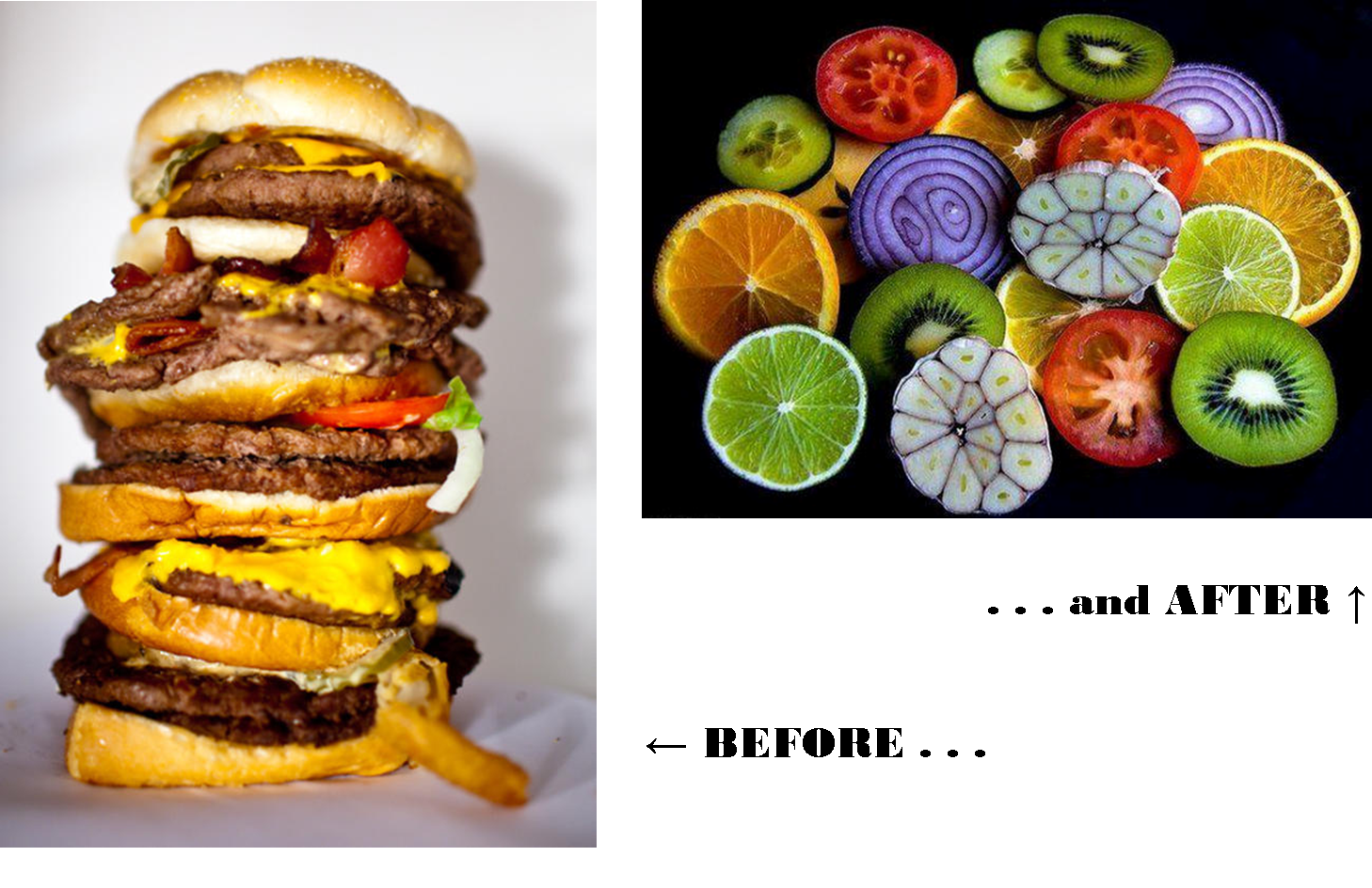
There's a scene near the end of the movie The Jungle Book. We come across a quartet of vultures -- who share a remarkable resemblance with a certain mop top boy band of the era. One of them keeps asking, "Whacha wanna do?" To which another answers, "I dunno, whachu wanna do?" They go back and forth like this for a while until they realize the futility of this circular conversation.
I'm on Day Two of my juice fast. (I know that some of the other folks at church are starting today, or don't plan to start until Sunday or Monday, but I started yesterday. It's easier if Day One is actually on the 1st of the month. Easier to keep track.)
Anyway, this is Day Two. And inside my head there's been a fairly constant dialogue. "Wacha wanna do?" I keep asking myself. "Eat." I reply. "No, seriously," I'll say, "what do you want to do? "Eat." comes the reply. "Eat. That. Now."
This is not surprising. Never before in human history have we had so much access to so much food. Or, at least, food-like stuff. In truth, many of us are hardly ever eating actual food most of the time, so perhaps it's more accurate to say that never before in human history have we had so much access to so many calories.
The Standard American (processed) Diet is calorie rich and nutrient poor. We are capable of consuming incredible amounts of calories while hardly getting any of the nutrients our bodies need. In fact, this is one of the explanations for our current obesity epidemic -- that even though we're eating more than enough calories to fuel our body's functioning our bodies keep crying out for the nutrients they need. This causes us to eat more food, and the food-stuff most readily to hand is the same stuff that didn't give us what we needed in the first place.
And so the activity of eating becomes nearly completely removed from the function of eating -- giving the body the nutrients it needs to live. Instead, eating becomes a comfort. Or a reward. Or an escape from boredom. Or an escape into boredom. Or a self-medication to reduce stress. Or anger. Or depression. Or . . .
So it's Day Two of the juice fast. And I'm getting all of the nutrients my body needs. And my digestive system is beginning to relax a bit from its usual overworked state. And the toxins are beginning to be dislodged from the places they've taken up residence in my system. And all of that is to the good, but I've also stopped trying to escape my boredom, or my feelings, or my whatever it is I've been escaping through eating.
And this is one of the benefits of a fast -- whether it's a fresh vegetable and fruit juice fast, or a FaceBook fast, or a fast from media. One of the benefits of a fast is that it separates out a behavior from the myriad of meanings we've superimposed on it so that we can once again engage it for its own purpose. After a period of withdrawal from these activities we can see them again for what they really are -- I eat to fuel my body; I go on FaceBook to connect with friends; I . . .
Of course, all of those things I've been trying to avoid or deny will begin to come more clearly into focus. While this is uncomfortable, to say the least, it also provides me with an opportunity to devise new ways of coping with them. Because, as I already know, eating is not the best way to deal with my emotions.
In the meantime, though I'm going to keep asking myself, "whacha wanna do?"
And while my habituated answer is "eat," at least for today I'm going to answer instead, in the words of Joe Cross: Juice On!
In Gassho,
RevWik
"We are one human family, on one fragile planet, in one miraculous universe, bound by love."
Showing posts with label juicing. Show all posts
Saturday, February 02, 2013
Thursday, January 31, 2013
T- Minus 1. . .
So . . . tomorrow's the big day. The official launch of the Thomas Jefferson Memorial Church's Health and Wholeness Initiative with the showing of the film Fat, Sick, and Nearly Dead and the beginning of a month-long juice fast. (We'll be showing the movie again next Tuesday, February 5th, and will be giving folks who'd like to try a juice fast -- but don't want to try going a whole month -- an opportunity to join the effort part-way through beginning on Wednesday, February 13th.)
I could have titled this post "Be Prepared," because that's what I want to look at -- preparation. How does somebody prepare for something like going without solid food for an entire month? Here are a few thoughts . . .
1) Recognize that this will probably be pretty hard. Lots of people find the first day pretty easy -- excitement, enthusiasm, endorphins. Some people find the first day incredibly difficult, but lots of folks find it easy. Perhaps deceptively so. The second and third days, though, most people report as challenging. There are a lot of changes going on -- physiologically as well as psychologically. For lots of folks there's actual withdrawal going on. So things start to get tough. But usually by sometime around day seven -- but maybe as late as the tenth day -- things begin to turn around. You start to feel incredible. Energy increases. Hunger and cravings (not always the same thing!) have really decreased. If you can get to this point, you're usually pretty much good to go for the duration.
2) Perfectionism can hinder progress. Another, and more well known, way to say this is, "the perfect is the enemy of the good." Some people, especially after seeing Joe Cross' movie, think that a strict regimen of vegetable and fruit juicing is the only way to go. And it's got to be sixty days or it's worthless. Neither is true. The whole purpose of something like a juice fast is to give your system a chance to "reboot" itself. The long-term goal, of course, is to make real and lasting change. So if you want to/need to modify the reboot a bit, that'll be better than doing nothing. So if "juice only" seems too austere, try adding in a smoothy or two. Some people find the added substance (not to mention the inclusion of more insoluble fiber) helps tremendously. Other people find that they can be successful when they juice for part of the day and then eat one healthful meal each day -- maybe a hearty vegetable soup or a serious salad. And perhaps it should go without saying that not doing a fast for thirty-days is not the end of the world. It's not failure. (That's why at TJMC we're giving an opportunity for folks to join the fast "already in progress" at the halfway point.) There's a scene in the movie in which Joe addresses this very thing, saying that if you succeed at juicing for ten days, or a week, well . . . in his Australian accent . . . "good on you."
3) Falling is not the same as failing. Some people feel that if they "slip" at some point during their fast, if they give in to their cravings and eat something, then they have failed. I can speak from personal experience of how easy it is to start thinking, "Oh, well, I've proven that I can't do this so I might as well give up." But there's a great Taoist saying that the definition of success is: fall down seven times, get up eight times. So . . . you succumbed to temptation and ate some of the veggies you were getting ready to juice . . . or you took a taste of the food you were making for your family . . . or you broke down and went through the drive-through. Okay. Not great, but not the end of the world. Pick yourself up and have another juice. Remember, the juice fast, in and of itself, is just a step on a much longer journey -- a lifelong journey of improving your health -- and as another Taoist saying puts it, "even stumbling steps lead not backwards."
4) Have a plan. Leonard Bernstein apparently once remarked that the way to accomplish great things is to have a plan and almost enough time. For us, the plan part means to have your juicer and know how it works. Have some recipes in place. Go shopping so that you have the ingredients you'll need. (Make sure to get lots of kale, carrots, apples and ginger!)
5) Remember that you're not alone. One of the reasons for offering this opportunity to the TJMC community is so that we can do it together. And throughout the month (or half-month) we'll be able to check in with one another, and keep each other inspired (and honest!), and remind each other that this really is worth doing -- that the health of our bodies is as important as the health of our spirits and our minds.
So . . . for those who can make it, see you tomorrow night, February 1st, at 6:30 pm.
In Gassho,
RevWik
Tuesday, January 29, 2013
T Minus 3 and Counting . . .
Perhaps you live here in Charlottesville and are planning to take part in the upcoming month-long juice fast being sponsored by the Thomas Jefferson Memorial Church - Unitarian Universalist. (Perhaps you're lucky enough to already count yourself among the members of the TJMC community!) Maybe you're reading this blog and are planning to join the fast from a distance. Perhaps you're thinking about watching all of this from a distance, taking your time to really think about the challenge and the changes involved.
No matter who you are, or where you are, there are some tips I'd like to offer. Today is T minus 3 days until the 1st of February, the official start of the month-long juice fast and the formal launch of TJMC's "Health and Wholeness Initiative." So here are some thought.
1) Please do check in with your doctor or other primary health care provider. I know. Everybody tells you to check with your doctor before you start an exercise plan, or begin a new diet, or even (according to Cialis) before starting to have sex (if you're of a certain age). And just as most people respond to the advise to read the manual before building that build-it-yourself furniture by not reading it, most people hear the advise to check in with your doc and then don't do so. So please, please, check with your doctor. Make sure that she or he is on board and keeping an eye on you -- especially if you're thinking about doing a month-long fast (or more). Depending on your current health and dietary habits, your body may be in for quite a shock and while it is probably going to be a good shock . . . well . . . a shock is a shock. And think about it this way: even if you don't think it's necessary to get your health care practioner's "permission," you'll have much better bragging rights at the end of this thing if you know what your numbers were at the beginning! So get some blood work done; go over your meds; make sure to note your weight on a standardized scale.
2) Take a "before" picture. Most everyone that I've encountered who has successfully completed a month-long "reboot" finds themselves looking markedly different than when they began. And I'm not just talking about weight lost here, although that usually does happen. People find that their skin glows more, those bags under the eyes have vanished, hair is more lusterous -- we look more energized. Being able to remind ourselves of what we looked like before is a great motivation for keeping healthier after.
3) Think about what folks in Overeater's Anonymous call "trigger foods." What is it that you most find yourself eating without thinking about it? What are you "called" to (or by) when you're feeling upset, or bored, or exhausted? If possible -- get those things out of your house. Now. Give yourselves a couple of days before begining the juice fast to get those temptations out of reach . . . and to begin clearing your body of them as well. Some people say to stop cold turkey, now, and to begin increasing the amount of vegetables and fruits you're consuming. Then, if you're like most North Americans, your body won't be as shocked when you suddenly start ingesting nothing but vegetables and fruits! (Other people suggest that you take one last bowl of Hagen Daas, or order one more McBurger, so as to say "goodbye" to these old friends.)
4) Go shopping. Have the produce you'll need already at hand. If you need recipes, many will be provided at the Friday night kick-off, but you can start by going to Joe Cross' website. Remember, at least if you're here in Charlottesville, you may well not need to have a juicer before beginning -- the church has purchased ten Breville juicers which we will be loaning on a first-come-first-served basis. (we're trying to eliminate as many hurdles as possible)
5) Last, for now, but certainly not least -- remind yourself that you really have no idea how this is going to be for you. You may have past experiences with fasting, or dieting, but unless you've tried a juice fast, after watching Joe Cross' movie, while being part of the supportive TJMC community . . . well . . . then . . . you don't really know what this will be like. When I did my first "reboot" back in May, I managed 30 days pretty easily. A bit of a challenge the first week, but by the end of that week the (re)new(ed) energy was its own motivation. The second time I tried it, however, I got through about 3 days before giving up on it. It can be ridiculously easy; it can be impossibly hard. But one thing that is certain -- none of us will be doing this alone.
I'm going to try to keep these blog posts coming, at least one per day, until the fast actually begins and, then, at least a couple of times weekly through the month of February. I hope that we can inspire and support one another in our free and responsible search for . . . better health.
In Gassho,
RevWik
Subscribe to:
Posts (Atom)