The other night I watched TV for the first time in a long time. No anti-boob-tube righteousness in that hiatus . . . I've been busy. But I did get a break the other night, and I tuned in MythBusters, and . . .
I was amazed at all commercials for food! It seemed as though food were being shoved in my face over and over again with a break only to tell me about how there was more food in another room somewhere. I was reminded of an experience I'd had at a wedding reception -- after half an hour or so of eating at the most splendiferous buffet you could ever imagine, it was announced that the appetizers were finished and it was time for us to go in to dinner!
For anyone who's not been following this blog, yesterday was Day 30 of a fresh vegetable and fruit juice fast. (See the movie Fat, Sick, and Nearly Dead to get an idea of what and why.) And today is 36 days since processed foods, fast foods, sugar, or the like have passed my lips. So maybe you can imagine the reaction I was having to this visual smorgasbord.
Or maybe you can't. Maybe you'd imagine that after a month of eating (drinking?) really healthfully all of this excess would have been unpleasant. If so, you'd be wrong. A Double Quarter Pounder from McDs? Heaven. A pepperoni pizza which cheese sticks for a crust? Seventh Heaven! I watched each and every image of food-like product that was being flashed before my eyes and I coveted it!
And what made this longing even worse was the fact that I know the changes I am making in the way I eat are permanent. I am not juice fasting so that I can return to eating poisonous food facsimiles. I am trying to heal my body and save my life. So I intend to finish this fast and switch to a nutrient-dense, whole-food, plant-based diet. As of this moment I think I'll be following the kind of diet advocated by Dr. Joel Furhman (among others), author of such books as Eat to Live and which he describes in great detail at his website.
But this means no more ribs. Ever. No more KFC. Ever. I will never taste the fabled deliciousness of Pizza Hut's Royal Crown Pizza. Even if it ever gets to the United States.
I love popcorn shrimp. (Heck, I like any kind of shrimp!) I love the aroma of barbecuing meat. And I could look at the changes I'm trying to make from a perspective of deprivation: I could focus on all of the things that I love to eat that I will never eat again.
Or, I could look at this from a perspective of opportunity: there is a world of amazing tastes out there just waiting to be discovered! Vegan food; raw food; unbelievably tasty things that I've never eaten because instead I've been filling up on fast food.
How do you look at your life? Do you focus on the things you don't have, on your longings? Or do you celebrate the things you do have, your gratitude? This choice makes all the difference.
In Gassho,
RevWik
Showing posts with label gratitude. Show all posts
Showing posts with label gratitude. Show all posts
Monday, May 14, 2012


Sunday, November 27, 2011
Gratitude – What Comes Next?

We’ve been sharing thoughts on gratitude this month.
Today we’re exploring “What happens when ‘thank you’
becomes not just our continuous prayer but also our way of life?” I wish I
could share with you my experiences as someone who has mastered thank you as my
way of life, but I haven’t. Not even close.
I have
been practicing gratitude more intentionally for the last few years. My partner
Jamie introduced me to a gratitude game—one in which I remind myself how truly
blessed my life is at those moments of frustration and annoyance—those times
when I am feeling particularly un-blessed, ungrateful. It is a very good game,
a good practice. I’d like to say I’m really good at it now, but I’m not. I guess
that’s why they call it a practice. I
know that’s one of the reasons I come to church. Being here, with all of
you, helps me practice being my best self.
Our exploration of gratitude, though,
has me thinking about the role of “thank you” in my life. When Meister Eckhart
said, “If you can only manage one prayer in your life, and it is ‘thank you,’
it will suffice,” exactly WHO are you saying thank you to? Because it’s a
prayer, I’m assuming he meant God. That makes sense when you are saying thank
you for some great cosmic miracle—the incredible beauty of nature or the birth
of a child. Thanking God doesn’t work for everyone, though, particularly the
atheists among us.
Today, then, I want to talk about the
more mundane, the quotidian events for which we are grateful. Take, for
example, an omelet. I’m not talking about just any omelet, but the most amazing
veggie omelet I had the other morning at Café Cubano. Hmm. I can taste it
now—mozzarella cheese, tomatoes, artichoke hearts, garlic. This is an omelet to
savor, which I was doing quite vocally. My dining partner also enjoyed his
omelet, but he took his gratitude one step further, stopping the passing waiter
to say, “Please tell the cook that this is one of the best omelets in
Charlottesville.” I imagine the ensuing conversation between the waiter and
cook, who might well have been grumbling about having to work on Thanksgiving
morning, but who was cooking with great care and delicious results. At the very
least, I imagine the compliment elicited a smile.
I can imagine her reaction because I’ve
had it myself. When someone thanks me for doing something, especially for
something I love to do, it reminds ME to be grateful. I think of the time a
student said to me, “Ms. Philips, thank you for teaching us.” Really, a middle
schooler said that. As you might imagine, this is one amazing kid, so my only
response could be, “Thank you, it is an honor to teach you.” Which it really
was. But his gratitude, and more especially his taking the time to share it
with me, makes me want to be an even better teacher.
The same is true for the work I do in
this church. For those of you who don’t know me, I’ve filled a few roles in
this church—serving on the board of trustees and a few other things. For the
most part, these have not been thankless tasks. I’ve been stopped short
after a meeting, a class, or a service—when one of you has come up to me and
said thank you. I’ve especially appreciated those thank you’s that come at
difficult times—when we’ve had to do the messy and hard work of being in
community. The thing that I like most about those expressions of gratitude for
what I do, though, is that they remind me how grateful I am. It truly is a gift to be able learn and grow within the
embrace of this community.
Thank you.
“From you I receive, to you I give, together we
share, and from this we live.”—these words resonate deeply for me, because I
know them to be true. (Pam Phillips)
*
* *
Thich Nhat Hanh – yes, another Tich Nhat Hanh
reference, and I thought I’d get it in real early this time – tells the story
of walking through the community in France where he lives and seeing a
beautiful smile on a little boy who was also walking there. “You have a beautiful smile,” the monk said
to the boy. “Thank you,” the boy said to
the monk. But reflecting on it later,
Tich Nhat Hanh decided that the little boy shouldn’t have said, “thank
you.” He should have said, “you’re
welcome.” Because the smile had been a
gift to him.
You know those visual tricks where the foreground
and the background have been so designed that if you focus on one you see one
thing and if you focus on the other you see something else? There’s the two faces looking at each other
and a candle stick or a goblet in between them.
There’s the old hawk-nosed woman with a headscarf who’s a vital young
woman in a fur wrap if you change your focus.


What if giving and receiving were like this,
too? What if gratitude and generosity
were really the same thing with the difference being merely a difference in
focus?
I want to take what might seem an odd tack here, but
bear with me. Okay?
Over the years I’ve heard people complain about God.
Oh boy have I heard people complain
about God. Lots of the folks who find
their way to Unitarian Universalist churches – not all, of course, but quite a
large number – have some serious issues with the religious tradition in which
they were raised.
And one of the things that a lot of these folks have
a problem with is the idea that God – if there were such a thing – would
require people to be good because they were afraid of being punished if they
were bad. That kind of God – the one
that “puts the fear of God into you” – just doesn’t make sense to these
folks. And being good out of fear of
what’ll happen to you if you’re bad just doesn’t seem right.
This is the theme of Anthony Burgess’ fantastic 1961
novel A Clockwork Orange and the film
adaptation Stanley Kubrick made ten years later. For those who aren’t familiar with them, the
main character, Alex, is the leader of a teen gang who engage in petty crimes
and “ultra-violence.” While in prison he
is subjected to an extreme form of aversion therapy that makes him virtually
incapable of any kind of negative behavior.
The prison chaplain reflects that this makes Alex’s apparent newfound
goodness nothing more than a mechanistic response, like a clockwork orange that
would look like the delicious fruit but would in reality be nothing more than a
machine. The book is, among other
things, a meditation on the question of whether one is truly good if she or he
is only good out of a fear of what will happen if they’re bad.
My only problem with this critique of God is that I
don’t believe that this is really what God is all about. Oh, for sure, there are people who’ll tell
you that this is what God is like. There
are even churches that’ll teach this, but I don’t believe that this is what the
idea of God is all about.
My reading – and I know that I’m not alone in this –
is that, far from doing good out of fear of punishment, we’re supposed to look
at the world we live in, to recognize all of the miraculously beautiful things
that surround us – from sunsets, to smiling children who say “thank you,” to really
great omelets, to great music in church on Sunday morning – and that we’re to
respond to all of these gifts by giving gifts of our own. It is our response to an awareness of how
truly blessed we are – not a fear of how punished we might be – that is
supposed to generate our goodness, our own giving.
From you I receive, to you I give . . . Giving and receiving intertwined. Gift and gratitude inseparable.
Like Pam, my gratitude practice is spotty at
best. Still, if I were to wait until I
had perfected this practice before moving on to the next, well, then I don’t expect
that I’d be moving on any time soon. Yet
the question comes up for many of us – what comes next? After gratitude, then what? Because it seems clear that if all we do is
sit around and feel grateful for all the good things in our lives and in the
world that that’d be a pretty dangerous practice. After all, can’t you imagine that a continual
focus on the all the good things in your life might well just lead to a sort of
pride? A sense of entitlement? Of “more grateful than thou?” (Come on, we know ourselves here; let’s be honest
– it’s possible, right?)
That’s probably why pretty much all of the religious
traditions I know anything about say that the remedy to such a take-over by
pride is to respond to gratitude with generosity. “Wow!
I’ve been given so much! What can
I give in return? How can I share from my bounty?”
I’m jumping the gun a bit on our upcoming pledge
campaign, I know, but I really can’t help myself because this is what I think
those things are all about. Oh, I’m sure
we’ll be talking about numbers and needs – how much money the church needs to
keep doing this and that – but I really don’t think that that’s why we should
engage in a pledge drive each year. If that
were our real motivation then we’d be no different than NPR – “you know you listen
so why not chip in?”
But just like everything else we do here I think
that this, too, should be part of the tools and tips for spiritual practice
that we offer our members. The real
question isn’t “how much has the cost of copier paper gone up in recent years?”
or “how badly do we need increases in staffing or space?” but, “how grateful am
I for what TJMC has brought into my life?
How grateful am I for these people and these experiences?”
The same is true of the Leadership Development
Committee’s survey that they gave out last week and that’s in the Order of
Service again this week. It’s not really
about “we have these holes in our leadership roster and need people to fill
them.” It’s really about offering each
of us a myriad of opportunities to find ways to move our gratitude into generosity.
From you I receive, to you I give . . . Giving and receiving intertwined. Gift and gratitude inseparable. “Thank you” and “you’re welcome” as mirror
images.
Actually, this reminds me of something that one of
my friends in Germany said tome. She was
always astounded that we, here, would respond to someone saying “thank you”
with the words “you’re welcome.” In
German, the response to “Danke”
is “Bitte” which, I’ve been told, really means “please.” So really the mirror might be “thank you” and
“please” – a different feel.
And the really cool thing
is that when our response to a gift – the “thank you,” an act of receiving – is
“please” – an invitation – then we magnify the spiritual benefits of our
gratitude. Some of the most grateful
people are those who give much, whether they themselves have much. Generosity increases gratitude.
And, of course, if we
practice rightly, gratitude increases generosity. From you I receive to you I give,
together we share, and from this we live.
The truth is that we can’t have one without the
other. Gratitude without generosity
begets pride; generosity without gratitude begets paternalism. But the two of them together? That’s the key to creating the Beloved
Community we dream about.
Sunday, November 20, 2011
Gratitude in a Complex Context

That was my childhood Thanksgiving. A small Midwestern town. The big white house
with the turreted front parlor, the wrap around front porch. The coats piled in the entrance room on the
bench, hats perched on the antlers of the Stag hanging on the wall. And people….me and my brothers and sisters,
mom and dad and my Grandparents, Aunts, uncles, cousins…and cousins….and
cousins. We could be a mass of humanity
numbering 30 to 40 filling that big white house with the roars of greeting and
the squeal of children wallowing in hugs and kisses from doting aunts and
uncles and grandparents.
There was the baby grand piano around which we gathered to
sing (Often in 4 part harmony), the living room where we crowded onto sofas and
laps and spilled over to fill the oriental carpet on the floor for the stories
and the now lost art of the parlor games.
There was the traditional touch football game in the sprawling side
yard, and the climbing race to the top of the three story blue spruce in the
back yard. And the aromas which filled every room with the hints of the dinner
feast soon to follow. It was
idyllic. Everything was perfect. Everyone was perfect. Life was perfect. And the world was
perfect.
And it remained that way until one day in college when I
learned that my perfect Midwestern town was a hotbed for the Klu Klux Klan, and
home to three John Birch Society chapters and that during the height of the
civil rights marches, town fathers were on the roofs of the Elks and the Moose
lodges on opposite ends of town with rifles and shotguns waiting for those
people to try to march into our town.
The Norman Rockwell façade began to fade away as the realities of the
underbelly of my perfect town were exposed.
And with the passage of time and of childhood innocence, my
perfect family began to take on more of the tarnish of common humanity. I can now see that the holiday suits,
dresses, perfumes and colognes only disguised the grudges and resentments and
harsh criticism underneath and do not resolve them. That, in addition to the hugs and the
casseroles and the candies and the flowers, other things also come in through
the door on Thanksgiving day. My
father’s and my uncle’s alcoholism. My
aunt’s mental illness. My cousin’s teen-age
pregnancy. My sister’s rape. My cousin’s drug dealing and drug abuse. These were also present within the annual
family gathering. As a wide eyed boy I
was totally oblivious to most of this history.
Even in adulthood it was never discussed –seldom even acknowledged
openly.
Yet this morning, I can still recall those Thanksgivings of
my childhood and how they were filled with love, with music and laughter, the
sense of belonging. I no longer see the
world as perfect or my family as perfect.
And, despite the erosion of some of my childhood naïveté, this remains a
Norman Rockwell, magical time for me. I
celebrate with thanksgiving for the goodness that coexists in the midst of the
imperfection. It is a time to gather
together, to remember, to celebrate and to be grateful. Happy Thanksgiving. (Bob Kiefer)
* * *
The Thanksgiving legend begins in Plymouth,
Massachusetts. The original feast was
probably held in early October 1621 and was celebrated by the 53 Pilgrims who
survived that first year, along with the Wampanoag chief Massasoit and 90 of
his men. Rather than the one day event we’ve become accustomed to – followed by
the obligatory “Watching of the Football Game” – this so-called “first thanksgiving” apparently
lasted for three days and featured a menu including numerous types of
waterfowl, wild turkeys, fish, and lobster, procured by the colonists, and five
deer brought by the Native Americans. (Right
now there’s a debate among some of my friends on FaceBook about whether or not
seal was also on the menu.)
Of course, now that I live here instead of on Cape
Cod I feel compelled to note that many historians point out that the first
thanksgiving celebration in what would become the United States was actually
held here in Virginia, where Thanksgiving services were routine as early as
1607. (Take that, Massachusetts!)
Be that as it may, though, in the popular mind the
“first Thanksgiving” took place in Plymouth, and the Commonwealth of
Massachusetts has staged a reenactment of Thanksgiving each year since 1921 (which
was the 300th anniversary of that 1621 harvest festival). People gather in 17th century costume at a church on the site of the
Pilgrims' original meeting house. After prayers and a sermon, they march to
Plymouth Rock. Not surprisingly, this annual event has become something of a
tourist attraction.
1970 was the 350th anniversary of the Pilgrim's
arrival. Wamsutta, a Wampanoag elder,
had been invited to the festivities to speak on behalf of the Native
peoples. The planning committee saw a copy
of Wamsutta's intended remarks in advance, however, and they expressed concerns
over what they described as the "inflammatory nature" of the
speech. They actually went so far as to
have a PR person rewrite it and they told him that he could either read their
revision or be disinvited.
So Wamsutta left the event and went to nearby Coles
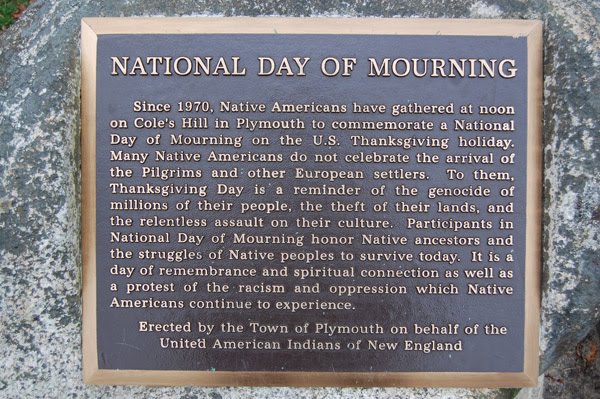
Hill, near the statue of Massasoit, and delivered his speech. A plaque, the one pictured on the cover ofyour order of service, marks the spot. This
is, in part, what he said:
"It is
with mixed emotion that I stand here to share my thoughts. This is a time of
celebration for you - celebrating an anniversary of a beginning for the white
man in America. A time of looking back, of reflection. It is with a heavy heart
that I look back upon what happened to my People.
Even before
the Pilgrims landed it was common practice for explorers to capture Indians,
take them to Europe and sell them as slaves for 220 shillings apiece. The
Pilgrims had hardly explored the shores of Cape Cod for four days before they
had robbed the graves of my ancestors and stolen their corn and beans. Mourt's
Relation describes a searching party of sixteen men. Mourt goes on to say
that this party took as much of the Indians' winter provisions as they were
able to carry.
Massasoit, the
great Sachem of the Wampanoag, knew these facts, yet he and his People welcomed
and befriended the settlers of the Plymouth Plantation. Perhaps he did this
because his Tribe had been depleted by an epidemic. Or his knowledge of the
harsh oncoming winter was the reason for his peaceful acceptance of these acts.
This action by Massasoit was perhaps our biggest mistake. We, the Wampanoag,
welcomed you, the white man, with open arms, little knowing that it was the
beginning of the end; that before 50 years were to pass, the Wampanoag would no
longer be a free people.
What happened in those short 50 years? What has happened in the last 300
years?"
The Thanksgiving legend and the Thanksgiving reality
do not always line up neatly.
In Steve Amick's book The Lake, The River, and theOther Lake, there is a scene which reminded me of something the theologian
Fred Buechner said about the Christian Scriptures – it’s "not too good to
be true, it's too good not to be true." As far as I can tell, nothing like this ever
actually happened, but it should have . . . and it most certainly has in
countless imaginations. The scene involves
Chief Joseph One-Song, an apparently fictional Ojibwe chief who, as one
character put it, "knew how to make a statement." In the
story Chief One-Song is invited to speak before the U.S. Congress in January
1837 at the granting of Michigan's statehood.
Let me read a bit of the book:
"The
chief's speech was actually only two lines – eight words plus a healthy helping
of wheeze and spittle . . . In translation from the Ojibwe, roughly: "You
have all been a great disappointment. When are you leaving?"
I can't find this anywhere in the history books but,
as I said before, it should be. It's
essentially what Wamsutta said at the first National Day of Mourning, that
Massasoit's "peaceful acceptance" of the Pilgrims was "perhaps
[the Wampanoag's] biggest mistake."
Now I feel compelled to point out that the NationalDay of Mourning, itself, is not without its controversy, even within the Native
American community. Russell Peters, one-time
President of the Mashpee Wampanoag Tribal Council has written:
"While the `Day of Mourning' has served to focus
attention on past injustice to the Native American cause, it has, in
recent years, been orchestrated by a group calling themselves the United
American Indians of New England. This group has tenuous ties to any of the
local tribes, and is composed primarily of non-Indians. To date, they have
refused several invitations to meet with the Wampanoag Indian tribal councils
in Mashpee or in Gay Head. Once again, we, as Wampanoags, find our voices and
concerns cast aside in the activities surrounding the Thanksgiving holiday in
Plymouth, this time, ironically, by a group purporting to represent our
interests."
And so even the protest is protested. Yet that makes the confusion greater not
less, doesn't it? Is the third Thursday
in November a Day of Thanksgiving or a Day of Mourning? Is it a day to celebrate universal
brotherhood and sisterhood, or a day to remember broken promises and a history
of oppression? Should we feel grateful? Or guilty?
These questions bring to mind for me some of my
favorite words from the author E.B. White:
"If the world were merely seductive, that would
be easy. If it were merely challenging, that would be no problem. But I arise
in the morning torn between a desire to save the world and a desire to savor
the world. This makes it hard to plan the day."
Because it's not just Thanksgiving Day that offers us
such a conundrum. It's virtually every
day. If you read the paper before
heading out in the morning do you curse the world or marvel at the blue
sky? Do you despair about the world
we're leaving our children, or wonder at the hope they innocently offer?
It’s often said that most ministers really only have
one sermon that they keep repeating in different forms. I think I have at least a couple. And one of them is that we need to strive to
retrain ourselves away from either/or thinking so that we can embrace the world
as it is, which is both/and. We are
called to save the world and to savor it – both. Life is full of sorrow and of joy – both. The glass is half full and it's half empty – both.
Actually, I saw a great cartoon recently. It shows a glass with water up to the midway
point. A line points at the bottom and
says, “1/2 water.” Another line points
to the top and says, “1/2 air.” The
caption reads, “Technically, the glass is always full.”

Two weeks ago we talked about the importance of having a
practice of gratitude, the development of an intentional awareness of the
miracles that surround us. And remember
Thich Nhat Hanh’s saying that the miracle is not “walking on water or walking
in the air but simply walking on this earth.”
Even without burning bushes we are surrounded by miracles.
Last week, though, we noted that sometimes life is hard –
sometimes really, really hard – and it might then seem to be impossible to be
grateful. And yet, perhaps, it’s exactly
at such times that it’s most important.
This week I want to make things a little more complicated
because, of course, we live in a really complicated world. Photons act as both waves and particles. 83% of the universe is something called “dark
matter” that we’re not even entirely sure exists. And, of course, the world is both challenging
and seductive, in need of saving and savoring both.
So the question this sermon was advertised to be about –
whether this coming Thursday is a Day of Thanksgiving or a Day of Mourning –
turns out to be just one version of a question we face all the time. It’s the same question as to whether Thomas
Jefferson is a paragon of liberty or a paradigm for oppression? It’s the question Bob brought home even more
personally for us – does the family glitter or is it deeply tarnished? Is this Norman Rockwell or Dorothea Lange?
I’m going to let you in on a little secret. There isn’t an easy answer. There isn’t some over simplification that
will work out all of the ambiguities and contradictions.
Life is messy. It
just is. It’s not always fair. Even when it seems fair in hindsight we discover how unfair it really was; and
sometimes when it seems downright mean-spirited we look back to discover
tremendous gifts. As Ian Anderson said
so long ago, “Nothing’s easy.”
The world we live in is not “black and white.” It’s not even “shades of grey.” It’s multicolored, a rainbow, with every
color coming in myriad hues and tones and shades. And the religious tradition we share, our
Unitarian Universalist faith, calls on us to recognize this complexity; to
acknowledge it; to embrace it; and to live in it.
There is much suffering, and there is cause for
celebration. There is promise, and there
is pain. Can you hold that? Can you live in that? Can you love that?
Sunday, November 13, 2011
But What If Life's Hard?
 If
it were up to me, I might just leave our TV on the Discovery Channel. After all, that’s where you can find MythBusters, and Dirty Jobs with Mike Rowe; Cash
Cab and Dual Survival. It’s the home of Shark Week, and that annual extravaganza of mechanization and
mayhem, Punkin’ Chunkin’.
Of
course, if we left the TV on Discovery then we’d miss out on some other family
favorites – Good Luck Charley, iCarly, Phinneas and Ferb, Spongebob,
and the kitty half-time show during the Puppy
Bowl. (Not to mention SyFy’s Eureka
and, okay I’ll cop to it, FOX’s American
Idol.)
Why
am I telling you all of this? I’ve been referring
a lot lately to the teachings of the Vietnamese Buddhist monk Thich Nhat
Hanh. I’m going to do so here
again. As anyone who knows his teachings
can tell you, Thich Nhat Hanh puts a great deal of emphasis on smiling as a spiritual practice. He has said, as do most Zen teachers, that
it’s essential to put in two daily practice sessions of at least twenty minutes
each. He has also said, however, that if
one can’t manage to do that that one session is better than nothing. And if you can’t manage one twenty minute session
each day, then you should aim for ten.
If even that’s impossible, then try and take five real breaths at some
point during the day. And if you can’t
do even that, then try to smile one fully authentic and aware smile before
getting out of bed.
Smiling
as a spiritual practice. He once
famously wrote that it is true that the world is full of suffering. This, after all, is the first of the Buddha’s
Four Noble Truths – “life is suffering.”
But Nhat Hanh doesn’t stop there.
The world is full of suffering, he says, but it is also full of the blue
sky and the eyes of a baby. “It would be
a shame,” he wrote, “if we were only aware of the suffering.” Breathing in, I relax body and mind. Breathing out, I smile.
But
one day one of his students approached her teacher and said, “But what if my
heart is full of sadness? How can I
smile?” What if I’m going through a
difficult period? What if I’m
angry? Or grieving? Or scared?
What if I’m trying to figure out how to keep everything from falling
apart? What if I can’t imagine how I’m
going to make it through another day?
How can I smile?
I
know this question. I’ve known heart
ache. I’ve known pain – physical,
emotional, mental, spiritual agony,
not to put too fine a point on it. I’ve
known loss, and I’ve known rage, and I’ve known fear. You have too, so we know this question – what
if our hearts are full of sadness? How
can we smile?
Some
of you know that I’ve been sick off and on for the past several weeks. Some of you have been in classes or meetings
that I’ve had to cancel or postpone; some of you have been wondering why I
didn’t respond to that e-mail or phone message you’d left. Some of you’ve seen me and just had the
feeling that something wasn’t right.
Most
of you, I hope, haven’t noticed anything.
I’ve been here in the pulpit or in the office; in a class or in a
meeting; and you haven’t had an inkling that there was anything wrong. As I said, I hope that this has been most of
you. But some of you have seen
something, and what you’ve seen have been the physical and mental
manifestations of the Depression I’ve been wrestling with off and on for some
time now.
No
doubt the stresses of the move here – both the challenges and just the newness
of it all – exacerbated something that’s normally quite well controlled. As most people who deal with depression will
tell you – those who have it and those who work with us – it can often be as
innocuous as well-monitored blood pressure or well-medicated allergies. But every once in a while it’ll flare up. Mine has been flaring lately.
So
I know the question of how can I smile when my heart is full of sadness,
because I’ve been asking myself that question a lot lately. How do I deliver a sermon on gratitude when
I’m feeling like this? How do I offer inspiration
or encouragement when I feel such a lack of both? The answer is the answer Thich Nhat Hanh gave
to his student, and it ties us back to my bit of personal revelation about my
viewing habits with which I began this sermon.
Each
of us, Nhat Hanh said, is like a television set. We each have many channels at our disposal –
perhaps as many as hundreds of channels we could have playing on the screen of
our life. Yet often we get stuck on just
one channel – sadness, anger, fear, playing it safe. Often we get stuck on just one channel – out
of all of the channels available to us – and then we begin to think of
ourselves as being that channel.
This,
of course, would be like my television set becoming convinced that it is the Discovery Channel. This is like me becoming convinced that I am my depression, or that I am my victimization, or that I am my hoplessness. I yam what I yam and that’s all that I yam.
But
the truth is far more complex. (Isn’t it
almost always?) Like a television set I
actually have hundreds of channels to choose from. I may, for any number of reasons, be spending
an inordinate amount of time on the Depression Channel, but somewhere on my
dial the Joy Channel is just waiting its turn.
Somewhere there is the Enlightened Buddha Channel. Somewhere there is the Christ Channel, and
it’s just as much a part of my basic package as is the channel on which I’ve
gotten stuck.
Because
life is full of suffering AND it is
full of the shinning eyes and impossible little fingers of babies; it is full
of cries of suffering AND quiet calm, both.
And when my heart is full of sorrow, when my life has gotten hard, when
the suffering overwhelms the miracles, then it is essential that I know where
to find the Gratitude Channel and switch out my viewing habits so as to remind
myself that life is more than the malaise.
This
isn’t easy to do. Sometimes it isn’t
even possible to do, not right now,
at least. Like during Shark Week you
really can’t change that dial right then.
Okay, that’s not my best analogy but I know you get my point. Sometimes it’s too much to even pick up the
remote and aim it at the TV; sometimes you just gotta lie there and watch
what’s on.
But
the time will come – often before you’re expecting it – that you can change the channels, and that’s
where the practice of gratitude comes in.
Practice something long enough, often enough, and it begins to become a
habit. Practice noticing the things in
our lives that we can be grateful for, and it begins to become a habit. A habit we can draw on, an autonomic reflex
we can stimulate, when we can’t do anything else.
One
of my favorite Tich Nhat Hanh-isms has to do with just how important it is to
make a practice of mindfulness, a practice of awareness, a practice of smiling, a practice of gratitude; how important it
is to make this practice a part of our lives during the good times, the easy
times. Practice, he says, is like sewing
a parachute, and you don’t want to begin sewing your parachute as you are jumping out of the
plane. You don’t want to begin sewing
your parachute as you’re jumping out of the plane. It’s important to develop the practice of
gratitude when it’s easy to do, so that you will have the practice to help you
when it’s not.
Last
week, in the depths of despair, I was forced to consider the practice of
gratitude because I’d promised to encourage you to consider it. It’s hard to immerse yourself in the
“attitude of gratitude” without at least a little of it rubbing off. And then there were Wendy’s reflections, and
Leia’s story, and Thomas’ ruminations (which he’d intended for this week but
which I needed – both professionally and personally – then instead), and there
was Scott’s music . . . and there was
the spirit of this community, a
wildly healing balm of breathtaking beauty.
(And as those of you on FaceBook know, on the way home I blasted some
Cream as loud as I could crank it.)
And
the channel changed. My mood
changed. The world I was living in – or,
more precisely, my perspective on that world – changed.
You
can smile when your heart is full of sorrow . . . because you can. Because, at some point, you have to. Because even if all you can manage is one
fully authentic and aware smile at some point during your day, it is another
stitch in your parachute. And if you can
keep up that stitching then when the time comes that you jump – or fall, or are
pushed – out of that plane, you’ll discover that you’re not really falling as
you’d feared you would be. You’re
flying.
I
want to leave you with a story. The
story of Samuel Hearne, who in the early 1770s was leading an expedition to
explore to the mouth of the Coppermine River in the Northwest Territories of
Canada. At one point in the journey his party was attacked by a party of Native
Americans who made off with most of their supplies. I don’t know whether this
incident occurred before or after a group of his party attacked and massacred a
group of Cooper Inuit at Bloody Falls.
But you can imagine the feelings after they were attacked and their
provisions taken –in a foreign and unknown land, a dangerous journey still
ahead, most of your provisions gone, the possibility of further incidents, the
guilt, the fear . . .
Now
I don’t know much about Samuel Hearne. I
haven’t been able to learn whether he had sisters or brothers; whether he’d had
a family of his own. He seems to have
been a good man who was truly horrified by the massacre carried out by his own
people. Still, I don’t know much about
Samuel Hearne, but I do know one thing.
I do know is that he was well practiced in the art of gratitude. I know this not because of any commentary
that survives about the man but because of the comment he made in his own
journal the day after the raid. With all
of the uncertainty, the tension, the anxiety that must have surrounded him at
that time, Samuel Hearne wrote these words: "The weight of our baggage being so much
lightened, our next day’s journey was more swift and pleasant."
That’s
someone who knew how to find the Gratitude Channel. "The weight of our baggage being so much
lightened, our next day’s journey was more swift and pleasant."
Sunday, November 06, 2011
The Practice of Gratitude
This month we begin our exploration of the
theme of gratitude. Of giving
thanks. And I’d like to begin with that well-known family grace — "For what we are about to receive may we be truly thankful." You may have
grown up saying this simple prayer before dinner, or maybe you remember
watching the Walton and Ingles families saying it
on TV — "For what we are about to receive may we be truly thankful."
A prayer of thanksgiving before the evening
meal.
I read a marvelous exploration of this
prayer, though, by a man who realized that this prayer from his childhood, this
prayer he knew so well, was not, after all,
the prayer of thanksgiving as he had always thought
it was. His father had led the family in saying that table grace every single
night of his childhood – a practice he continued with his own family. It had become part of the rhythm of his
life. Yet one day it struck him that
this grace he’d been saying every night was not a prayer of thanksgiving but
was, instead, a prayer of petition — not "for
what we are about to receive we are truly thankful," but, "for
what we are about to receive may we be truly
thankful." This prayer was not about giving thanks but about asking for the
gift of gratitude.
The truth is, it can be hard to say,
"thank you."
Well, that's not really true. It's easy to
say "thank you," but it can be tremendously hard to really mean it. To say, with all your heart and soul,
"thank you" is a very humbling thing. It
means admitting that there was a hole in my life which you have just filled,
that there was something I needed which you had and which I
now have only because of your generosity.
American popular culture praises self-sufficiency, honors those
who stand on their own, asking for and
needing nothing from anyone but themselves. Did John Wayne or Clint Eastwood
ever ask for help when they were cleaning up a town? Did Sigourney Weaver ask for help when she was battling aliens? They all got help, of course, lots of it, but
they never asked for it and they never really did say "thank you" afterwards. These heroes, these
American Icons are, in fact, always the ones being thanked, the ones to whom everyone else goes for help. John
Donne aside, these figures are islands,
standing alone and aloof, needing no one. Strength of Character, in popular American imagery, means never having to say
"thank you."
I've often wondered why it's so hard for
people to write "thank you" notes. (Perhaps
it's "better to give than to receive" in part because when you
receive you've got write all those notes!) Sometimes I think it's
because we're expected to say "thanks" for socks and underwear —
never an easy thing.
Still, I think a bigger part of the reticence is simply because it can
be so hard to say "thank you." You've got to humble yourself, you have to acknowledge both your lack and the other person's
fullness, you need to publicly state that you
cannot stand alone. To say “thank you”
is another way of saying “I need you.” Rarely
an easy thing, either.
In
the thirteenth century the Christian mystic Meister Eckhart famously said, “If
you can manage to utter only one prayer in your life, and it is, ‘Thank You,”
it will suffice.” “If you can manage to
utter only one prayer in your life, and it is, ‘Thank You,” it will
suffice.”
“Thank
you” may be difficult to say (and really mean), but apparently it’s pretty
powerful when we do. So let’s dig into
this a little bit.
Some
of you may know that we Worship Weavers have a wiki with which we wonder with
one another about the themes that we’re exploring. Any of us – all of us – are able to access it
and add our thoughts, whether we’ll be actively involved in a particular
service or not. It’s an experiment as of
now, yet as it develops I can imagine opening it to the larger congregation so
that our pre-sermon conversation can be even more rich and full.
Thomas
Collier put in his two cents for this service and suggested that we look at the
20th century German philosopher Martin Heidegger. (Now I know that for some people Heidegger
is, if you’ll excuse me, verboten,
because of his membership in the Nazi party and his statements in support of
Hitler. I believe that this demonstrates
that not everything he thought is worth our attention, but don’t believe that
it negates all of his insights into dasein
– being.
Heidegger
argued that we live in what we might call an “average-everydayness.” Most of us are living most of our lives
immersed in the day-to-day, moment-by-moment, stuff of our existences. The
philosophers Lennon and McCartney put it like this.
“Woke up, fell
out of bed. Dragged a comb across my
head. Found my way downstairs and drank
a cup. And looking up, I noticed I was
late.”
(That’s
from their seminal work, “A Day in the Life.”)
Heidegger
said that we live the vast majority of our lives in such
“average-everydayness.” And, to be even
more clear about it, this “average-everydayness” has something of a negative
cast to it. We don’t tend to notice, to
be aware of, the things that go right in our world, the things that go
according to plan; we take these things for granted. The water’s hot in the shower; the microwave
heats my breakfast; the car starts and gets me here on time. None of this usually rises to the level of my
conscious attention.
Yet
the moment it’s only cold water coming out of the shower, or my breakfast
explodes in the microwave, or the car won’t start . . . then I begin to notice things.
Then I’m aware of them. When things work the way they’re supposed to
I glide by on autopilot; when things break down I have a laser-like focus.
Here’s
another example: this summer a lot of us
were complaining about how hot and humid it was. Couldn’t stand another minute of it. When was it ever going to end? But how long did the “not-hot-and-humid” days
last before we started complaining about how it’s too cold
The
“not-hot-and-humid” days. There are a
whole lot more of them than the hot and humid ones. The Vietnamese Buddhist monk, poet, and peace
activist Thich Nhat Hanh has a teaching he calls “the non-toothache.” When we have a toothache all we can think
about is how wonderful life will be when this our tooth stops hurting. Oh, it will be heaven, nirvana. And yet, when our
tooth actually does stop hurting, we quickly go back to living our
“average-everydayness;” we lose touch with the miracle of the “non-toothache.”
How many of us woke up this morning singing praises
to the sun because that pain we’d had a couple of weeks ago—the one we’d
forgotten about until I just brought it up, thank you very much—that it was
gone? Or because that thing we’d been so
worried about last month had resolved itself?
I’d wager that most of us have either completely forgotten about these
things or had simply gotten absorbed in this week’s traumas.
But it’s worth noting that they’re gone. It’s over—whatever it was, it’s over. Or even if it’s not over—if whatever was
troubling you is with you still—it will be over someday. Everything ends sometimes, because life just
doesn’t stay in one place that long. And
the question is, will we notice its absence when it’s gone? Are we aware of the non-toothache?
Last
night a friend of mine posted this on FaceBook:
Kid broke my printer tray, trapped
herself under the bar stool in the kitchen, rubbed chocolate cake into the
couch, threw crayons at the restaurant, mixed my rock shrimp tempura sauce with
ranch dressing (with the aid of a french fry), kicked the dog, watched one
episode of Scooby Doo and now will not stop yelling that she "hears a
ghost!!!!" and put 45 puzzle pieces in my bed. I do believe I am a happy
as I have ever been.
This
is someone who, in that moment at least, was fully in touch with the
“non-toothache.” The story of what this
woman went through to adopt her beautiful little “bee” is one I won’t infuriate
you with. (And believe me, it would
bring you to a fury.) And yet, throughout
that entire ordeal she kept thinking about how glorious it would be when she
was finally united with this little girl, her daughter. And so, even after a day like the one she
described in her post, she remembers, and “glorious” it most certainly is.
When I was growing up I read a lot by the
author and Episcopal priest Martin Bell.
In one of my favorite passages he wrote, "Being thankful means
saying yes to life in spite of all the obvious suffering
and brokeness and guilt that's involved. It means enduring unbearable hardships
for no other reason than to show up again
tomorrow and be part of this whole wild cosmic adventure."
Living a Life of Gratitude, keeping always a "thank you"
on our lips and in our hearts, is the key to living a life of Joy, and both are
tied in with being Awake and Aware. Living life
so that you see the lilies of the field, how they grow; so that you see the
colors changing on the trees and notice how the sun plays on the mountains; feeling the warmth in a loved one's touch, hearing
the love (or hurt, or joy) in their
voice. To be thankful for the miracles of life we must be awake enough to see
them; to be thankful for gifts given we must be aware they have been received.
To be awake, to be aware, to be
alive.
To be sure, this is a practice. It takes, at first, a conscious effort to
stay in touch with the miracle of the mundane – we’re so much more accustomed
to being aware of the problems and looking for the burning bushes. Yet every day of non-toothache, or not-hot-and-humid,
is a blessing. A gift. The Venerable Thich Nhat Hanh says that the
true miracle is not walking on water or walking on air, it’s simply walking around
on this earth.
I want to leave you this morning with an
anonymous quotation a friend gave me a long time ago that has inspired me ever
since:
"You are alive. It needn't have been so.
It wasn't so once, and it will not be so forever. But it is so now. And what is it like: to be alive in
this maybe one place of all places anywhere
where life is? Live a day of it and see. Take any day and be alive in it.
Nobody claims that it will be entirely painless, but
no matter. It is your birthday, and there are many presents to
open. The world is to open."
And
for that, may we be truly thankful.
Thursday, October 20, 2011
Of Gratitude and Grace
Last evening a group of us gathered at Thomas Jefferson Memorial Church - Unitarian Universalist to explore the topic of "gratitude." We've recently begun organizing our lifespan faith development efforts -- and in this I include our weekly worship -- around monthly themes. In September we explored "hospitality." In October we're dancing with "Atonement." Next month our theme will be "gratitude," and our conversation last night was a way for our religious education leaders, and anyone else who was interested, to get a head start on thinking about our next month's focus. (And the rich conversation also gave me gold for the sermons I'll be preaching!)
One of the things we did during this Conversation on Gratitude was to create collaborative an acrostic poem. We thought about words that we associate with the idea of "gratitude" and then we took one of those words and wrote it vertically down the side of a piece of paper. We then brainstormed words and phrases which begin with each of the letters of that word, and wove those together to create our poem. (This is one of the things that our congregation's children will be doing during their religious explorations next month.)
Here is the poem we created:
Gift of gladness
Received and reciprocated.
Aware of awe. Ahhhhhhh.
Cultivating communion with the cosmos.
Embodying the energy of the entwined.
In Gassho,
RevWik
Subscribe to:
Posts (Atom)