Thursday, February 15, 2007

More About FUUCSL

Yesterday I wrote about the First Unitarian Universalist Church of Second Life. It turns out that I'm not the only one. (No surprise there!) A colleague of mine, the Rev. Christine Robinson, who serves the First Unitarian Church of Albuquerque, has written a lot about this virtual congregation in her blog, iMinister. One of her recent posts goes into a fair amount of detail.

Today I also received an e-mail from the (one of the?) founder(s) of FUUCSL in which he wrote:
There is going to be an article published in USA Today next week about the church!!! One of the issues that the reporter, Cathy Grossman, Religion and Spirituality Correspondent, is going to cover is whether a virtual church can serve real spiritual needs. I can assure you that it does and Cathy interviewed several people from our church besides myself, including the Reverend Christine Robinson from Albuquerque and one of our members who is disabled and homebound and who has been able to reconnect to her spirituality through our church and who feels a calling to help others in her situation through online ministry.

Our oldest member of the church is 74 years old and he is an active participant. Many of our other members are in their 40s and 50s. Technology is certainly involved, but it is not so great that it cannot be overcome, as has been demonstrated by the multitude of people who show up at our virtual church who can barely figure out how to walk or sit down, but they do and they stay because of the welcoming, calming and spiritual atmosphere that we provide.

What rich potential there is in this new technology. There's potential for problems, of course, and much has been written and discussed about the danger of this kind of "virtual" community, about how it could lead to even further isolation and alienation, yet people report that they are finding real community there. And if people are going to spend hours upon hours in these virtual worlds, shouldn't we establish outposts of sane and salvific community?

By the way, in terms of stats: the FUUCSL has been in existence for about six months. In that time it has gained 180 members, it has well over 50 people who regularly attend worship , and its membership has doubled in the last two months. FUUCSL is already the second largest church in Second Life. It would be interesting to see how many of these folks are already UUs, or now seek out a brick and mortar UU church, and how many make this their only church home.

in gassho,

RevWik

Wednesday, February 14, 2007

Virtual Church

It seems that almost everywhere I turn these days I'm hearing about Second Life--the virtual "universe" that is taking our "real" world by storm. People are spending up to forty hours a week--and beyond--in this cyber reality. News organizations like Reuters and the Wall Street Journal now have reporters whose full-time beat is covering the goings on in this virtual reality.

And now, for those who say that they are too busy in Second Life to go to church, there is the First Unitarian Universalist Church of Second Life. Apparently they have worship services on Thursday nights and Saturday mornings. If you're interested, here is a link to a promtional video that gives a little flavor.

Who knows where this might lead, but people report that they really do find a real feeling of real community in places like this cyber world. Perhaps we'll one day have full service congregations--just like those brick and mortar churches we're already familar with--speaking to the needs of folks and of the wider Second Life world.

Yours in Gassho,

RevWik

Thursday, February 01, 2007

This world is SO wonderful!

I sometimes--actually, with a fair bit of regularity--run across a story that reminds me how truly wonderful this life is. It's so easy to get caught up in the day-to-day of my own existence, to begin to believe that what I experience is pretty much what life is like.

And then I hear about a guy like Paul Woods. He's the 44 year old man who's driving from Alaska to Virginia--a trip of more than 4,500 miles--on his Toro lawnmower! He's on his third engine, has only three of his original five gears, and can reach speeds of up to 15 miles an hour . . . when he's not weighed down by the grocery cart he's pulling as a trailer with his tent, his tools, some food, and his dog, Yoda. Oh, and he left in 2005!

Woods says that he was in Alaska caring for his mother, and that with her death he's now on an odyssey to claim the house (in Virginia) that she left him in her will. Why he's doing it on a lawnmower isn't reported in any of the news stories that pop up when you google this. (83 as of tonight!)

But I don't really care why he's doing it. What matters to me is that he is doing it--that somewhere out there there's a guy who's riding across the country on a lawnmower. With his dog in a shopping cart/trailer. And who's living a life I could not even begin to imagine.

What matters to me is that life includes so much more than what I'm experiencing, so much more than I'd ever be able to experience . . . yet it is being experienced! Life is so much more vast and wide than my little parcel, yet I am part of that vastness. My life is a part of the rich tapestry that is Life. Yours, too.

Isn't that wonderful?

in Gassho,

RevWik

Monday, January 22, 2007

More About Angel del Basuero

As a follow up to my most recent posting I want to give you a couple of other links about the Angel del Basuero--the Angel of the Garbage Dump--Hanley Denning.

The Portland Press Herald ran a really nice article about Hanley. And here's a really lovely report on her stateside memorial service, held in Yarmouth.

According to another Press Herald article, there is a film, Recycled Life, that is a 38-minute documentary about the people who live and work on and around the Guatemala City Dump. It has now been nominated for an Academy Award. Here is an article about the film, and here is a link to the film's web site where you can watch the trailer and pre-order a copy of the DVD.

And, of course, if you haven't yet, visit the Safe Passage/Camino Seguro site to see for yourself what this young woman's vision and passion brought into being.

In Gassho,

RevWik

Friday, January 19, 2007

There's One More Star in the Heavens, and the Earth is Less Luminous

Hanley Denning, a young woman from Yarmouth, Maine, went to Antigua to learn Spanish. What she found there was the poverty and the pain of the families living on and around the Guatemala City Dump. Larger than several football fields, the dump was "home" to generations and Hanley knew she had to do something.

Her story could easily be a TV movie--as she told it to me my mouth kept dropping open at the sheer unlikeliness of it all--yet every scene would be true. She sold her car and her computer and began to try offering services to the children of the dump. A priest offered her an unused chapel at the edge of the dump and by herself Hanley began to clean it up. Some local kids started hanging out; then they started helping. The local drug dealers tried to run her out. She stayed. The vision grew.
That was in 1999. Today the organization she founded--Safe Passage/Camino Seguro--serves over 550 children. Each child receives assistance with homework and hands-on learning activities designed to reinforce basic primary school concepts; they also participate in a range of programs such as art, music, sports, English classes, and computer instruction.
Safe Passage also provides nutritional support, an on-site clinic, vocational training, and clubs for children and their mothers. And they have early intervention programs, adult literacy programs, and residential care for children coming from the most dangerous and unstable living situations. Volunteers come from around the world to be a part of this incredible program, all of which came into being because one woman knew she had to do something about the horror she saw in front of her.
When I interviewed Hanley for the radio show I briefly hosted in Portland, Maine, I left the studio knowing that I had been in the presence of a living saint. The fact that she would have been incredibly uncomfortable with that description was one of the reasons I felt so sure. Hanley was a living demonstration of the words of Edward Everett Hale: "I am only one, but still I am one. I cannot do everything, but still I can do something. And because I cannot do everything, I must not hesitate to do the something that I can."

Hanley died in a car accident yesterday, January 18th, 2007. If it's true that when a person dies a new star shines in the heavens, it is no less true that today the world is less luminous for this loss.

in Gassho,

RevWik

Saturday, January 13, 2007

One word . . . plastics


There are some wonderful benefits to having children. Lots of them, actually, but yesterday I was appreciating one in particular--the chance to watch children's television. My youngest and I were watching an episode of Reading Rainbow which was focusing on recylcing. There was a brief piece on the development of technologies that can turn corn into plastic!

Surplus corn can be harvested and turned into plastic that can be made into everything from containers to utensils to clothing, and when the product's usefulness has ended it can be composted. So you can recycle not only your old vegetable scraps but the bags the vegetables came in in the first place!

Is this a great world or what?

in Gassho,

RevWik

Thursday, January 11, 2007

How Far Have We Come?

I'm preparing my sermon for the Martin Luther King, Jr. weekend and so am considering the state of race in America today. On the one hand, Massachusetts recently swore in its first--and the country's second--African-American governor and Barack Obama is considered by most a serious contender for the White House in 2008.

On the other hand, thanks to the NAACP's magazine The Crisis I came across a truly disturbing seven minute video documentary called A Girl Like Me. A high school student named Kiri Davis was working on a project for her literature class in which she was interviewing young women of color. Over and over again issues having to do with societal assumptions about beauty and the girls' sense of self kept coming up. She thought it might make a good documentary film and, as part of the Reel Works Teen Filmmakers project she created her film. [You can watch it at the Media That Matters Film Festival website. This link brings you to the Festival's home page; this one brings you right to the film.]

A Girl Like Me contains interviews with some young women of color, but the really disturbing thing is Davis' recreation of the 1947 "baby doll" tests of Drs. Kenneth and Mamie Clark. In this test, identical dolls were presented to a child and the child was asked to identify the “nice” doll, the “bad” doll, and the doll he or she would rather play with. As I said, these were identical dolls, down to their clothing, except for the color of the doll’s skin. One was white and one was brown.

In his original experiment, which was used as one of the arguments in the Supreme Court’s Brown vs. Board of Education desegregation decision, Clark found that of the sixteen children between the ages of six and nine he tested, ten of them chose the white doll as their preference, ten of them considered the white doll the "nice" doll, and eleven of the sixteen called the brown doll the "bad" doll.

Ms. Davis recreated this experiment down to the exact wording of the questions for her film in 2005, and of the twenty-one children she studied eleven picked the white doll over the black doll. When asked why the white doll was the “nice” doll she was told, by the most innocent little faces you’ve ever seen, “because it’s white.” When asked why the black doll was “bad,” she was told that it was because “it’s black.” And most heart rending of all, when she asked the kids, as Dr. Clark had asked them in the ‘40s, “Which doll looks like you?” you can see the confusion, the hesitancy, and the hurt as they push forward the black doll they’d just denigrated.

So what's happened to the Rev. Dr. King's dream that people will be judged "not by the color of their skin but by the content of their character"? We may have come a long way, but we have a long way still to go.

In Gassho,

Rev. Wik

Tuesday, January 09, 2007

The Real Issue

A member of the congregation I serve in Brewster, MA suggested that we create buttons that read:

"What God has joined together let no one break asunder . . . save gay marriage!"

We may be getting into the button business in the near future (keep watch on this space for more information!), but it's assured that we're going to be getting BACK into the fight for marriage equality. With the recent vote of the State Legislature folks are coming forward more committed than ever.

I want to make two points that just keep coming up for me in all of the debate around this issue:

First, some people say that "marriage" must be reserved for heterosexuals because "the purpose of marriage is procreation." If that's really true, then people who bear children out of wedlock, and folks like my wife and me who are married but unable to conceive children, are likewise a threat to the institution of marriage. Until the opponents of marriage equality begin a campaign to somehow deal with these two groups I will always suspect that this isn't their real concern.

Second, when opponents of marriage equality talk about the "sanctity of marriage" being under attack by gays and lesbians who want their unions to be recognized and don't also demonize adulterers and batterers and, for that matter, the producers of "Who Wants to Marry a Millionaire" I also find their arguments less than convincing. Which is more destructive of a sense of the sacredness of the institution--no-fault divorce or a couple of women who've been committed to one another for over thirty years wanting to get married? I get the idea that the "sanctity of marriage" isn't really what's worrying them, either.

The last point I want to make is not mine, but Welton Gaddy's. Rev. Gaddy is President of the Interfaith Alliance, a Baptist minister, and host of State of Belief a weekly radio show that airs on AirAmerica Radio. At the time the so-called Defense of Marriage Act was being debated he wrote:
“For those people who want to protect marriage, let me offer a few suggestions: Raise the public’s consciousness of the dignity and importance of women in our still deeply patriarchal society; increase the minimum wage and offer tax breaks to the working poor so that spouses can see each other for quality lengths of time, rather than briefly passing on their way to two jobs; encourage family planning; start a plan to deal with domestic violence; and work to cover mental health care in medical insurance policies so serious emotional difficulties can be prevented from tearing marriages apart.”

But somehow I get the feeling that "defending marriage" isn't really the issue that they're talking about either.

Hmmmmm. I wonder what is.

In Gassho,

Rev. Wik

Tuesday, January 02, 2007

At the End of Our Rope

The deposed leader of Iraq Saddam Hussein has been hanged before the eyes of the world--quite literally, because of a leaked videotape of the hanging. Called a brutal dictator, a murder, responsible for untold crimes against his neighbors and his own people, his removal from power has been the retrofitted reason the Bush administration has given for our invasion of Iraq. (Before the war, you may recall, it was because of "weapons of mass destruction;" after no such weapons were found, the rationale morphed into "regime change.")

His death may well be justice for his crimes; the world may in fact be better of without Saddam Hussein in it. I am in no position to judge. But the image of a man falling to his death at the end of a rope in a world where that image can be captured on a cell phone and almost instantaneously sent around the world via the Internet--that upsets me. It's like one of those episodes of Star Trek when Kirk and company land on a planet with tremendously futuristic technology on which everyone nonetheless acts as if it's Earth's "old west." The juxtaposition is jarring. What are we doing hanging people--anyone--in the twenty-first century?

Albert Einstein once famously said, “The significant problems we face cannot be solved at the same level of thinking we were at when we created them.” When will we learn that war is not the way to make peace? That fear and hatred cannot bring a shift to love? That murder--even state sanctioned murder, even for one who deserves to die--is simply not right?

I hope it's soon enough because at times I fear that it's we who are at the end of our rope.

in gassho,

RevWik

The Golden Rule

I recently moved to Massachusetts, proud to be living in the first state in Union to recognize that there is no legal impediment to two people--regardless of gender--joining their lives in marriage. Folks may have their own moral, religious, and/or philosophical perspectives--it is still a free country, after all--but from a purely legal standpoint there's no reason heterosexual couples and homosexual couples should be treated differently.

Today the state legislature voted to move forward a proposed ammendment to the language of the state constitution which would define marriage as between one man and one woman. I'm hearted to note that the vote was 61 for to 132 against, but still the measure needed only 50 votes to move forward.

I wish they'd read my recent editorial in the Cape Cod Times. (You have to scroll down a bit to get there, but it's there: "Two dimensions of marriage.") Or, if not me, I wish they'd listened to our state's Governor-elect, Deval Patrick, who said:
"Above all, this is a question of conscience. Using the initiative process to give a minority fewer freedoms than the majority, and to inject the state into fundamentally private affairs, is a dangerous precedent, and an unworthy one for this Commonwealth," he said in a statement. "I hope by whatever means appropriate, the constitutional convention today ends this debate."

But it won't, of course. As with the debates around abolition, and women's sufferage, and civil rights for African Americans, this debate will continue. Why, though, in this nation which so many continue to call a "Christian nation" is it so hard for folks to put into practice what Jesus taught as the heart and soul of his message: do unto others as you would have others do unto you? (Or, as another religious tradition puts it, what you would not have someone do to you, do not do that to someone else.)

Yours in Gassho,

RevWik

Wednesday, August 23, 2006

How are we doing?

It has been said by some that God created the world in six days, completing the task and resting on the seventh. One week, and all that is was brought into being. Evidence that suggests--strongly suggests--that millenia were involved and that a laborious process of trial and error and chance and adaptation--in other words, "evolution"--is dismissed as being too flimsy to stand against the revealed word of God. (A pretty conclusive way of closing down the argument.) And so people who're open to the discoveries and insights of modern science have often turned their backs on religion since so many religious folks have clearly turned their backs on science.

There are, of course, many religious people who do not find these two worldviews to be incompatible. As with poetry and prose, or classical music and jazz, the same thing can be expressed in different ways and science and religion can be seen as two different lenses offering different ways of looking at the world around and within us. Genesis can be seen as a poetic interpretation of the world's evolution and humanity can be seen as co-creator with the divine in the on-going creation of the world.

I came across sad evidence of humanity's creativity. A new island has emerged in the Pacific Ocean, partway between California and Hawaii. It is roughly twice the size of Texas. And it is entirely made up of pastic bags, fishing nets, empty bottles--garbage. Called the Eastern Garbage Patch it is yet another piece of evidence of human civilization gone wild.

Whether God created the world and appointed us stewards, or we are co-creators, we need to be doing a better job.

in Gassho,

Rev. Wik

Tuesday, June 13, 2006

Talk About Line Dancing!

Sometimes we human beings are capable of the most sublime vision. Think of the image of one person dancing alone. Now add a partner. Now two or three more. Now see in your mind's eye a hundred people dancing together. Now several hundred.

Now imagine that while those several hundred people are dancing together there are, somewhere nearby, another group dancing. And not that far away, another. Don't you get a sense of the increase in power and connectedness?

On Saturday, June 24th, at 7:00 pm, dancers in seven sites along the Mississippi River--from the headwaters at Lake Itasca to the delta at Plaquemines Parish--will join together in a dance over two thousand miles long! Radio stations in each of the seven cities will simulcast, so that dancers in one place can actually call to, and be heard by, dancers in another. It will be the largest site specific, free dance performance ever.

This just makes me happy. Like the millennial New Years' Eve with its synchronized coverage celebrating midnight as it moved across the globe, the idea of people dancing together along the entire length of the mighty Mississippi fills me with hope. Sure, no one is being fed or clothed. People will be homeless still, and racism and other oppressions will not cease. But what an inspiring manifestation of coming together; what a promise of what's possible when we engage our creativity and ask "why not?" instead of saying "we can't."

For more information on this incredible event, look up One River Mississippi.

In Gassho,

RevWik

Tuesday, May 23, 2006

¡Ay, caramba!

The United States Senate recently passed a resolution declaring English to be our "national language." Some people were surprised, having assumed that English already was our national language. After all, it was the language in which our forbears wrote the Declaration and the Constitution; Lincoln delivered the Gettysburg Address in English, and it was the language Ronald Reagan used to tell Mr. Gorbachev to "tear down [that] wall." Most people in this country speak English, and it still serves as the lingua franca of the world.

Yet English has never been officially declared our national language. We’ve apparently never before thought it necessary to have an official national language. In fact, in recent years the movement has been toward trying to recognize and honor the multiplicity of languages spoken by U.S. citizens with bilingual and multi-lingual services proliferating. English certainly predominates in American discourse, but do we really need to call it the one true American language?

Christianity has been the religion of the majority of Americans, and one form or another of it was the religion of most of our forebears. Should Christianity be named our national religion? Should jazz, or country and western, or rock and roll be declared our national music? Should meatloaf and mashed potatoes or the greasy diner cheeseburger be declared the national meal?

Of course, the "melting pot" metaphor has long been used to describe the American ideal. They come to this country from wherever they're from and, in the great melting pot that is American culture, become like us. This model has encouraged immigrants to assimilate, to actively strive to be absorbed into the larger dominant culture, to let go of the cultural norms of their homeland and to adopt the norms of America. The arguments for an official national language draw from this longstanding tradition—we’re told that naming English as the national language will aid the assimilation process and increase unity in our country.

And this all might sound good on the surface, yet the underlying assumptions are inherently racist. That's because the "us" who "they" must become like are almost invariably white, Anglo-Saxon, heterosexual males. I know because I am one and the cultural norms that go largely unquestioned in our country are based on, and cater to, people who look and sound pretty much like me.

If you're also a heterosexual, European-American male you may not know what I'm talking about—that's why it's sometimes called "invisible white privilege." We don't usually see it because we're so fully immersed in it—like a fish in water—that we don't need to be aware of it. But just ask someone who looks, sounds, or acts differently and they can tell you how difficult it is to hear over and over again, "you are welcome here as long as you become like us—in other words, as long as you become somebody else."

Sociologists have long suggested that the metaphor of the melting pot—which was always more of an ideal than a reality anyway—should be replaced by the image of a "tossed salad" or a “smorgasbord” in which each of the individual elements retains its own uniqueness while creating together a richness that none could achieve on its own.

And if only unconsciously, the dominant majority culture recognizes this. Who would eschew sushi, tacos, bagels, or pizza simply because they’re not “American” foods? Where would we be without espresso and chai? Wouldn’t we be the poorer without the mambo of Tito Puente, the reggae of Bob Marley, and the symphonies of Beethoven?

According to a recent Washington Post article one in three U.S. residents—and nearly half of the nation’s children under five—are members of a racial or ethnic minority. This suggests that in the not too distant future the demarcations between majority and minority will be getting blurry. Is this what’s feeding the sudden urgency for a national language? As Sen. Barbara Boxer asked during debate on the Senate’s resolution, “Are we that insecure about ourselves?” If so, and if we give in to that fear, we will all be the poorer for it. Oye gevalt!

In Gassho,

Rev. Wik

Monday, May 15, 2006

To Savor or To Save?

I was sitting in our sanctuary, listening to the incredible jazz of the Stan Strickland Quartet. And, yes, this is in part a plug for the wonderful new ministry of music we've begun here known as the Maine Jazz Festival Series. (You should check out the web site at http://www.themainejazzfestival.com/.)

Anyway, I was sitting in our sanctuary as these cool/hot sounds washed over and through me and I started thinking about all the other clubs and concert halls around the country—and the world—where people were at that very moment listening to other incredibly talented musicians. I started by thinking about other jazz concerts, but quickly realized that while I was listening to Stan there were folks also listening to country, and bluegrass, and opera, and rock, and hip hop, and táncház, and klezmer, and reggae, and salsa and every other musical style known to humankind. And I felt myself connected to each and every one of these other aficionados, and for a moment, it was as if I could hear all at once the music they were hearing and could feel all of their joy. Tears came to my eyes.

And then a second window opened in my soul and I began to hear the sounds not of music but of what the Bible calls “weeping and gnashing of teeth;” I heard the moaning sounds of mourning. During the couple of hours I’d been at this concert roughly 7,200 people had died on our planet, and who knows how many other people had experienced who knows what kinds of tragedies? While I sat listening to music there were people dying of AIDS, and hunger, and domestic violence, and war, and overdose, and suicide, and cancer, and accident, and neglect, and exposure, and murder, and every other way people die in our world. (Not to mention all the people who were right then experiencing racism, and heterosexism, and sexism, and poverty, and every other kind of oppression; people who were losing their jobs, and their families, and their hope—all the people who were suffering in all the ways we humans can suffer.) And I felt myself connected to each of these people, and the people to whom they are connected, and for a moment it was as if I could hear all of that agony and feel all of their pain. You’d better believe it—more tears.

And the question: What should I do? Should I keep sitting here listening to music when there’s so much that needs doing? What a luxury to be listening to music when there were people who were at that very minute suffering terribly! Shouldn’t I be doing something? I started to become overwhelmed with guilt and despair.

E. B. White—the renowned Maine-based New Yorker essayist; author of such classics as Charlotte’s Web, Stuart Little, and of course, Strunk & White’s The Elements of Style—once succinctly summed up life’s fundamental problem:
“If the world were merely seductive, that would be easy. If it were merely challenging, that would be no problem. But I rise in the morning, torn between a desire to save the world and a desire to savor the world. That makes it hard to plan the day!”

The Unitarian Universalist tradition I serve encourages us to embrace both those things that need saving in our world and those which call out to be savored. White’s problem is our problem—we don’t really get to choose because it’s a both/and proposition. Life demands both our best efforts and our deepest appreciation.

So I continued to take in the sounds of Stan Strickland and his band and tried to keep open that connection to both the joys and sorrows of life. That way, when I do the things I can do to try to make this world a better place, I know there’ll be a song in my heart.

In Gassho,

Rev. Wik

Tuesday, May 09, 2006

The Temple & The Meeting House


One element of the tremendously exciting experiement in liberal religion known as the Charles Street Meeting House was the transformation of its sanctuary. Its minister, the Rev. Kenneth L. Patton, argued that there are essentially two kinds of religious buildings: the temple and the meeting house. The meeting house is familiar to anyone who's grown up in New England. Largely devoid of any ornamentation, it presents a blank canvass. As Patton wrote in his classic 1964 work A Religion for One World, the meeting house is,

"simply a place of meeting. It is a shelter for fellowship. Its emptiness is to be filled with people and invites the inner quietness of the worshipers. The building says nothing. If anything at all is spoken, it is by the people gathered in it. Its emptiness does not intrude an outer form or dication upon the inner light of the attendent." (pp. 85-86)

The other form of religious structure is the temple. Of this he wrote,

"The temple is just the opposite. It has a central theme or meaning in its dominant architectural symbol, and it is often lavishly decorated with related symbols and art. . . . The temple itself is an expression of a vision of reality and life. . . . [I]nstead of being merely the bare room in which a sermon is delivered, the temple preaches its own sermon through architectural and artisitic voices." (p. 86)

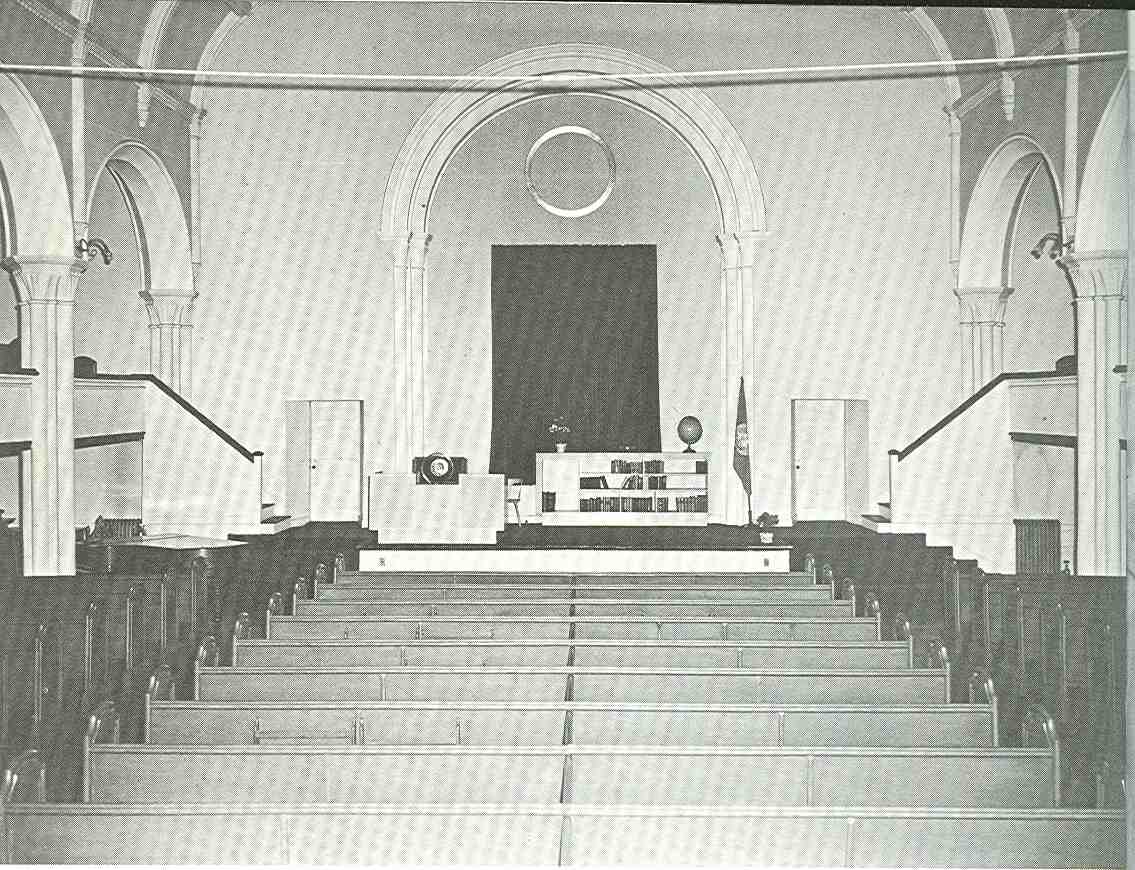
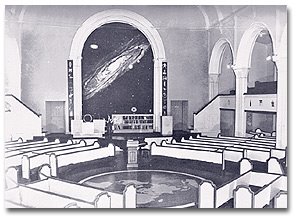
One of the first things Patton and the congregation did was to transform the Charles Street sanctuary from a meeting house into a temple. The totality of this transformation can be seen in these pictures. You can see the pews moved into a circle, surrounding an inlayed imaged of earth, so that the parishioners can see one another and know themselves to be representatives of the whole human race. You can see, too, the painting of the Andromeda Nebula in the apse which was balanced by a mobile of the atom at the other side of the sanctuary, so that the parishioners know their place in the cosmos as between the atom and the stars. The altar is a bookcase, filled with the world's scriptures, poetry, philosophy, and science. Adorning the walls are symbols of humanity's strivings, and art reflecting humanity's yearnings. Truly a temple of a "universalized Universalism."

The Unitarian Universalist Association sold the Charles Street Meeting House in the late 1970s. Today it houses not a worshiping congregation but offices and shops. This temple is no more. Yet the vision lives on, not just in congregations like the First Unitarian Society of Schenectady, NY but also in every congregation that prominently displays the symbols of major world religions. There was more to it all than this, of course, and I plan to come back to Patton and his vision in the days and weeks to come.

In Gassho,

Rev. Wik

[P.S. -- For more information on Patton and the Meeting House you can check out Kennan Pomeroy's research paper: Kenneth L. Patton: A Citizen of the World.]

Sunday, May 07, 2006

A priest, an imam, and a rabbi walk onto a soccer field . . .

Sounds like a set-up for a joke, right? Well, according to the May 1 issue of the Times of London, that's just what's going to happen in Berlin during the run up to the World Cup finals! A team of Mulsim Imams will play against a team of Christian Priests, and organizers are hoping for a Jewish Rabbi to referee.

The biggest hurdle, as of now, is finding a good date. Friday is the day of prayer of Muslims; Saturday's out as it's the Jewish sabbath; and Sunday would be a tough day for the Christians. Still, if they can work this out, can world peace be far behind?

In Gassho,

Rev. Wik

Thursday, May 04, 2006

Speaking Truth to Power

I have just finished watching one of the most amazingly daring demonstrations of a true clown--the trickster unafraid to speak truth to power--Stephen Colbert's performance at the White House Correspondents' Association Dinner. Largely overlooked in reports on the event by the mainstream media, this thirty minutes is a stunning response to everyone who wonders why nobody's saying out loud what's so obvious to so many of us--that the Emperor has no clothes, and is actively stealing ours. It must be seen to be believed.

And just before watching it --or immediately after--you must also check out fellow UU blogger Philocrites' very insightful piece "Bush, Colbert, Lear and the Fool."

As a one-time "holy fool" I'll just add to Philocrites' comments with two quotations about the clown, the fool, the trickster:

"Why is it that fools always have the instinct to hunt out the unpleasant secrets of life, and the hardiness to mention them?" (Emily Eden)

"Jesters do oft prove prophets." (Shakespeare)

Tuesday, May 02, 2006

Introductions

"Here is Edward Bear, coming downstairs now, bump, bump, bump on the back of his head, behind Christopher Robin. It is, as afar as he knows, the only way of coming downstairs, but sometimes he feels that there really is another way, if only he could stop bumping for a moment and think of it. And then he feels that perhaps there isn't. Anyhow, here he is, at the bottom, and ready to be introduced to you. Winnie-the-Pooh."


I've always loved this passage, the first paragraph of the first chapter of Winnie-the-Pooh. I used it as the reading for my first sermon in my first church, the Unitarian Universalist congregation I have served for the past eleven years, the First Universalist Church of Yarmouth, Maine. It seems like such a good way to introduce the idea of introducing oneself.

So here I am, introducing myself to whoever you are reading this. My name is Erik Walker Wikstrom and I am, as I've said, currently the pastor of the First Universalist Church in Yarmouth. In August I'll be moving to serve a new congregation, the First Parish in Brewster, Massachusetts. These days I am filled with both a lot of sadness about leaving Yarmouth, and a lot of excitement about arriving in Brewster.

I'm also filled with a lot of thoughts--musings about the meaning of life, about the state of politics in the United States, about the condition of our culture, about movies, and comic books, and parenting, and God, and . . . So I've decided to join the bloggosphere.

It is my hope/plan to post here at least weekly, more often when there's something worth saying. I hope, too, that you'll come back often and post your own thoughts.

Yours, in Gassho,

Rev. Wik